Lined paper in 6 mm, 10 mm and B5 notebook ruling
Each setup opens the generator with that ruling and paper size, so you can change the margin line, header or line color before you download.
6 mm narrow feint (A4)
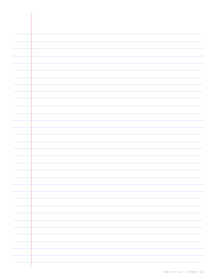
Lines 6 mm apart with a red margin 30 mm from the left, like a UK narrow feint refill pad. 42 lines on A4 and 38 on Letter, for small handwriting and dense notes.
10 mm extra-wide lines
Lines a full centimeter apart, wider than wide ruled. 23 lines on Letter and 25 on A4, for early writers, low vision and large handwriting.
B5 lined paper (6 mm B-ruled)
Japanese B5 (182 × 257 mm) with 6 mm B-ruled lines, no margin line and room at the top for a date and title. 37 lines, like a Japanese school notebook or loose-leaf refill.
What prints with the starting settings
| Paper | US Letter — 215.9 × 279.4 mm (8.5 × 11 in) |
|---|---|
| Line spacing | 7.14 mm = 0.281″ |
| Ruling | College ruled |
| Writing lines on this page | 32 |
| Margins | 1/2″ |
| Line weight | 0.18 mm (bold 0.35 mm) |
| Print setting | Scale 100% / Actual size |
Standard line spacing
| Line spacing | Millimetres | Inches | Lines on Letter | Lines on A4 |
|---|---|---|---|---|
| Wide 11/32″ | 8.73 mm | 0.344″ | 26 | 29 |
| College 9/32″ | 7.14 mm | 0.281″ | 32 | 35 |
| Narrow 1/4″ | 6.35 mm | 0.25″ | 36 | 40 |
| Medium 8 mm | 8 mm | 0.315″ | 29 | 31 |
| 6 mm | 6 mm | 0.236″ | 38 | 42 |
| 10 mm | 10 mm | 0.394″ | 23 | 25 |
What lined paper is for
Lined paper is the most ordinary page in any classroom or office, and that is exactly why it is useful to be able to print it. Students run out of notebook paper the night before an assignment is due. Teachers need a specific ruling for a worksheet or a writing test. Writers and letter-writers want a quiet page with generous spacing for drafts or correspondence. Lawyers, managers and students who like legal pads can print the familiar double top rule on Letter or Legal paper and staple their own pad together.
Because you control the spacing, you can also print ruling that is hard to find in shops, such as 10 mm lines for people with large handwriting or low vision, tight 6 mm ruling for compact notes, or the B5 pages of a Japanese notebook.
Wide, college, narrow and metric ruling
Three rulings cover almost every need in North America, and a few metric spacings cover most of the rest:
| Ruling | Line spacing | Lines on Letter | Lines on A4 | Typical use |
|---|---|---|---|---|
| 10 mm extra-wide | 10 mm (about 0.39″) | 23 | 25 | Early writers, low vision, marker pens |
| Wide (legal) | 11/32″ (8.7 mm) | 26 | 29 | Elementary school, large handwriting, letters |
| Feint | 8 mm | 29 | 31 | UK and European exercise books |
| College | 9/32″ (7.1 mm) | 32 | 35 | High school, college, everyday notes |
| Narrow | 1/4″ (6.35 mm) | 36 | 40 | Compact handwriting, dense notes |
| 6 mm narrow feint | 6 mm | 38 | 42 | Small handwriting, lecture notes |
Line counts use the default margins (half an inch on Letter, 10 mm on A4) and 22 mm of space above the first line. Outside the US, A4 paper is usually ruled at 7 or 8 mm, often with a margin line, and A5 notebooks commonly use 6 or 7 mm. Pick a preset or type your own value. If you are matching a notebook you already own, measure across ten lines and divide by ten.
6 mm lined paper (narrow feint)
Six millimeters is a real stationery ruling, not just a custom setting. In the UK it is sold as narrow feint on A4 refill pads, alongside the more common 8 mm feint. In Japan it is B-ruled (B罫), the everyday ruling of school and university notebooks, which are usually B5 rather than A4. The 6 mm setup adds a red margin 30 mm from the left, like a UK refill pad; switch it off for full-width lines.
It is slightly tighter than US narrow ruled (6.35 mm) and holds 42 lines on an A4 page, about a third more than 8 mm ruling, which adds up quickly over a notebook. That density suits:
- University students taking dense lecture notes.
- Writers drafting by hand who want a full page to feel like a lot of text.
- People with small handwriting who find college ruling too roomy.
- Language learners copying out vocabulary lists.
10 mm lined paper (extra-wide lines)
Most lined paper is designed for practiced adult handwriting. Ten-millimeter ruling, a full centimeter between lines, is for writers who need more room:
- Young children who have outgrown the three-line structure of handwriting paper but still form large letters.
- People with low vision, who often write bigger with thick markers and need lines they can see.
- Adults with arthritis, tremor or other conditions that make small, controlled letters tiring.
- Stroke and hand-therapy patients relearning to write, for whom generous spacing reduces frustration.
- Anyone writing with a marker or brush pen, where strokes are simply too thick for narrow lines.
Think of the wider rulings as steps on a ladder. Wide ruled at 8.7 mm is the largest standard school ruling; 10 mm adds about 1.3 mm per line, roughly 15% more height; half-inch Pitman ruling at 12.7 mm is for genuinely large script, marker work and shorthand. If someone keeps drifting above the line on wide ruled but looks lost on half-inch lines, 10 mm is usually the right fit.
Contrast matters as much as spacing for many of these writers. In Advanced options, a deep navy line at 0.5 mm weight stands out under poor lighting without the harshness of pure black, while the red margin line gives a clear starting point for each row. For classroom use, add name and date header fields and set Pages in the PDF to the number of pupils. For whiteboard-style marker writing, turn the page to landscape and switch off the margin line so the lines run across the long side. Matte paper reduces glare for low-vision readers, and a slightly heavier sheet stops markers bleeding through. For drawing and maths at the same spacing, use 1 cm dot grid.
B5 lined paper and Japanese A, B and C ruling
Walk into any stationery shop in Japan and the shelves are full of B5 notebooks with fine B-ruled lines. B5 gives plenty of room for notes, and 6 mm ruling fits neat handwriting closely, so a page holds a lot. Printable pages in the same format are useful for refilling loose-leaf binders, for practice outside Japan, and for anyone who likes the size.
Japanese notebooks label their ruling with a letter on the cover. On a JIS B5 page (182 × 257 mm) with 15 mm left at the top for the date and title, and no margin line:
| Ruling | Line spacing | Lines on JIS B5 | Typical use |
|---|---|---|---|
| A罫 (A-ruled) | 7 mm | 31 | Larger handwriting, younger students |
| B罫 (B-ruled) | 6 mm | 37 | The everyday school and university ruling |
| C罫 (C-ruled) | 5 mm | 44 | Very small, dense writing |
The B5 setup uses B-ruling; type 7 or 5 mm for A or C ruling. Switch the paper size to ISO B5 (176 × 250 mm) for European notebooks, which gives 35 B-ruled lines. Use the pages for lecture notes, for Japanese, Chinese or Korean vocabulary in neat rows with readings on the line above, or for journals with the date in the header space. Japanese B5 loose-leaf binders usually have 26 rings, so punch the pages with a matching punch or turn on alternate margins. For a squared or dotted page in the same size, use B5 graph paper or the 5 mm dot grid.
Tips for useful lined pages
Leave room at the top. The default Space above first line is 22 mm, which gives you a header band for a name, date or title. Shrink it toward zero if you want writing lines from edge to edge, or raise it for a letterhead.
Use the margin line deliberately. The red vertical line is not decoration: it keeps text clear of binder rings, gives teachers somewhere to mark, and creates a column for dates or question numbers. For journaling or calligraphy drafts you may prefer it off.
Lighten the lines for final copies. Under Advanced options, choose a pale gray or light blue line color and a thinner line weight. The page still guides your handwriting but looks cleaner if you scan or photocopy it. Soft gray lines also suit journals on narrow 6 mm ruling.
Try dashed lines for tracing. Setting the line style to dashed or dotted makes a softer guide for practicing lettering over the top.
Setting it up in the generator
Choose Lined paper as the paper type and pick the paper size first, since Letter, A4, Legal, A5 and B5 each change how many lines fit. Then:
- Select wide, college or narrow ruling, or enter a custom line spacing in millimeters or inches.
- Turn the red margin line on or off and adjust its position if needed.
- For a legal pad look, switch on Double rule at top, choose Legal or Letter, and either load yellow paper or set a pale yellow paper color under Advanced options.
- Add Hole-punch guides for binders, or Alternate margins for binding if you are printing double-sided pages for a notebook.
- Add header fields and set the page count if you want a whole pad in one PDF.
When it looks right, download the PDF, or copy the link to share the exact ruling with a class.
Printing tips
Print at Actual size (100%) so the ruling matches the size you chose; Fit to page shrinks the spacing by a few percent and adds a line or two. To check, measure ten line gaps: on college ruled they should span 71 mm, a little over 2 3/4 inches; on 6 mm ruling 60 mm, and on 10 mm ruling exactly 100 mm. If your printer is off, the calibration page corrects it once and for all. No B5 paper? Print the B5 pages at 100% on A4 and trim them to size.
For double-sided notebook pages, print the odd pages, flip the stack and print the even pages, or use your printer’s duplex option. Standard 20 lb (75 g/m²) copy paper is fine for pencil and ballpoint; for fountain pens or gel ink, 24–28 lb (90–105 g/m²) paper reduces bleed-through.
Popular lined paper sheets
- College ruled paper (Letter & A4)
- Wide ruled paper (Letter & A4)
- Notebook paper (college ruled, with holes)
- A4 lined paper (8 mm feint with margin)
- Narrow ruled paper (Letter, A4 & Legal)
- Writing paper (wide lines for letters and stories)
- Genkō yōshi (Japanese manuscript paper)
- Legal pad paper (yellow, Legal & Letter)
- Seyès paper (French ruled)
- A5 lined paper for journals and planners
- Arabic lined paper (right-hand margin)
- Wongoji (Korean manuscript paper)
- Pitman ruled paper (1/2 inch lines)
Frequently asked questions
What is the difference between wide ruled and college ruled paper?
The distance between lines. Wide ruled (also called legal ruled) spaces lines 11/32 inch, or 8.7 mm, apart. College ruled uses 9/32 inch, or 7.1 mm. Narrow ruled is tighter again at 1/4 inch (6.35 mm). Wider lines suit younger writers and larger handwriting; narrower lines fit more words on a page.
How many lines are on a sheet of college ruled paper?
With the default half-inch margins and header space, a Letter page in this generator has 32 college-ruled lines, and an A4 page has 35. Wide ruling gives 26 lines on Letter and narrow ruling 36. Changing the space above the first line or the margins changes the count, and the spec table shows it live.
How does 6 mm lined paper compare with narrow ruled?
US narrow ruled is 6.35 mm (1/4 inch), so 6 mm is slightly tighter: 42 lines on A4 against 40. It is sold as narrow feint in the UK and is the B-ruled spacing of Japanese notebooks. If your letters touch the line above, try 8 mm feint on A4 lined paper.
What are A-ruled and B-ruled lines?
Japanese notebook rulings. B-ruled (B罫) lines are 6 mm apart and A-ruled (A罫) lines are 7 mm apart; C-ruled (C罫) is 5 mm. B-ruled is the most common for school and university notebooks. The B5 setup gives 37 B-ruled lines on JIS B5 and 35 on ISO B5, with 15 mm left at the top for a date and title.
Is 10 mm lined paper good for low vision?
Many people with low vision find wide spacing and heavy, dark lines easier to follow. Start from the 10 mm setup, then in Advanced options choose a deep navy line color and a 0.5 mm line weight. Write with a black felt-tip, and consider printing on matte, off-white paper to cut glare.
Where does the red margin line go?
On US notebook paper the vertical margin line sits 1 1/4 inches (31.75 mm) from the left edge, and that is the default on Letter. On A4 it defaults to 30 mm. You can move it, recolor it or switch it off under the paper settings.
Can I print lined paper that fits a 3-ring binder?
Yes. Turn on Hole-punch guides (3-ring) and the page shows where to punch, so the holes clear the text area. Keep the margin line on, since it already leaves a blank strip down the left side for the rings. Japanese B5 binders usually have 26 rings; for those, punch with a matching punch or turn on alternate margins.
Which ruling should a child use?
Most US schools move from primary handwriting paper to wide ruled around second or third grade, then to college ruled in middle school. Children who can form letters without a dashed midline but still write large, often around first and second grade, may do better on 10 mm lines. For early writers who still need a midline, use handwriting paper instead. Our ruling-by-grade guide walks through each stage.
Can I make the lines wider or narrower than the standard rulings?
Yes. Type any line spacing from 4 mm up to 20 mm. Below about 5 mm most handwriting becomes hard to read; for 1/2 inch lines, see the Pitman ruled page.
Can I make a lined notepad with a header on every page?
Open Advanced options, add header fields such as Name, Date or Subject, then set Pages in the PDF to however many sheets you want. Each page gets the same header, and you can number the pages at the bottom.
Last updated · About us