Why ruling should change with age
Line spacing is a target. A five-year-old forms letters with the whole arm and needs a tall space to fill; a high schooler taking notes writes small and fast and wants as many lines per page as possible. Giving a young child college ruled paper forces cramped, illegible letters, while giving a teenager primary paper wastes most of the page.
The progression most American schools follow runs from tall, three-line primary paper to wide ruled, then college ruled, with narrow ruled as an option for small writers. There is no national standard for the early stages, and handwriting programs vary, so treat the measurements below as typical starting points rather than rules.
The stages at a glance
| Stage | Paper | Typical measurement |
|---|---|---|
| Pre-K and kindergarten | Primary handwriting paper | About 1 in from top line to baseline |
| Grade 1 | Primary handwriting paper | About 3/4 in |
| Grade 2 | Smaller primary paper | About 5/8 in |
| Grade 3 | Smallest primary paper | About 1/2 in |
| Grades 3–5 | Wide ruled | 11/32 in (8.7 mm) |
| Grade 6 and up | College ruled | 9/32 in (7.1 mm) |
| Small writers, adults | Narrow ruled | 1/4 in (6.35 mm) |
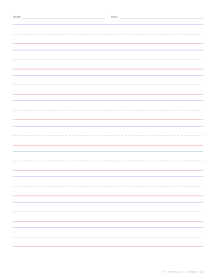
Here is what each ruling looks like at true proportions, all cut from the same corner of a printed Letter page:
- Kindergarten primary1 in sets
- Grade 1 primary3/4 in sets
- Grade 3 primary1/2 in sets
- Wide ruled11/32 in, 8.7 mm
- College ruled9/32 in, 7.1 mm
- Narrow ruled1/4 in, 6.35 mm
And how many lines or writing sets fit on a page, straight from the generator with its default margins:
| Paper | K (1 in) | Gr 1 (3/4 in) | Gr 2 (5/8 in) | Gr 3 (1/2 in) | Wide | College | Narrow |
|---|---|---|---|---|---|---|---|
| US Letter | 8 | 10 | 11 | 13 | 26 | 32 | 36 |
| A4 | 8 | 11 | 12 | 14 | 29 | 35 | 40 |
Kindergarten to grade 3 — primary handwriting paper
Primary paper uses sets of three lines: a solid top line, a dashed midline and a solid baseline, usually with extra space between sets so descenders on one row don’t collide with tall letters on the next. Each letter has a clear target. Tall letters like b, d and l touch the top line, small letters like a, o and e stop at the midline, and letters like g, p and y dip below the baseline.
- Kindergarten paper is the tallest, around one inch from top line to baseline. Children are still learning letter shapes, so big targets help. Our kindergarten paper is set up this way.
- First grade usually steps down to about 3/4 inch, the default in the generator. See first-grade paper.
- Second grade often uses 5/8 inch sets (second-grade paper), and third grade half-inch sets, the bridge between primary paper and wide ruled.
Two settings make a real difference for beginners. Shade the middle zone tints the space between the midline and baseline, which shows children exactly where small letters live. Show descender line adds a line below the baseline for tails. Both are in the generator’s handwriting options.
Starting cursive
Cursive is usually introduced in second or third grade. Children still benefit from a midline at this point, because joining letters at the correct height is the hard part. The third-grade paper uses smaller sets for this transition, and cursive paper adds optional slant guides.
Grades 3–5 — wide ruled
Once letters are consistently sized without a midline, children move to wide ruled paper, also called legal ruled in some regions. The lines are 11/32 inch (8.7 mm) apart with a red or pink margin line 1¼ inches from the left edge. This is the default for elementary school composition notebooks and spelling tests.
Wide ruled gives a nine- or ten-year-old enough room for clear letters while teaching them to work without a visual crutch. Print wide ruled paper with a name and date header for worksheets and journal prompts.
Some teachers keep a pack of primary paper on hand in third and fourth grade for students who need more support, or for spelling practice where letter formation matters. Mixing papers in one classroom is common and sensible.
Middle school and up — college ruled
College ruled paper has lines 9/32 inch (7.1 mm) apart. Despite the name it is standard from roughly sixth grade, and it is the default in most spiral notebooks sold in the US. On a Letter page with half-inch margins it fits 32 lines, against 26 for wide ruled — about a quarter more writing per page.
This is the right paper for note-taking, essays and homework once handwriting has settled into an adult size. For structured note-taking, Cornell notes use the same 7.1 mm spacing with a cue column and summary box.
Narrow ruled
Narrow ruled paper (1/4 inch, 6.35 mm) suits people with small, neat handwriting, and is popular for dense lecture notes, planners and journaling. It is not usually a school requirement, but it is a good option for older students who find college ruled too roomy. A metric equivalent, 6 mm lines, is common on European paper.
Outside the US
Schools in other countries follow different traditions, so this ladder is American. Many European schools use metric line spacings such as 8 mm or 9 mm for younger students and squared paper for maths from the start. French schools use the distinctive Seyès ruling. If you are matching a non-US school, measure a sheet of the paper students already use and type that spacing into the generator — it accepts any value in millimetres or inches.
Setting it up in the generator
- Pick Handwriting paper for K–2 or Lined paper for wide, college and narrow ruling.
- Choose a spacing preset, or enter a custom value if your school’s workbook uses something different.
- Open Advanced options and add header fields such as Name, Date and Class.
- For a stack of practice sheets, set Pages in the PDF and turn on page numbers.
- Use Copy link to share the exact setup with a colleague or parent; the settings live in the URL.
Printing tips for classrooms
- Print at 100% / Actual size so the lines measure what they say. A Fit-to-page dialog shrinks a 3/4 inch set to roughly 0.71 inch.
- Light blue or grey lines photocopy more faintly than black; if you plan to copy a master, choose a slightly darker line colour.
- Turn off the margin line on primary paper if children keep starting their writing in the wrong place; on wide and college ruled sheets keep it, as it is part of what students are practising.