What prints with the starting settings
| Paper | US Letter — 215.9 × 279.4 mm (8.5 × 11 in) |
|---|---|
| Letter height | 3/4″ (x-height 3/8″) |
| Rows on this page | 8 |
| Lines | 2 |
| Margins | 1/2″ |
| Line weight | 0.25 mm (bold 0.35 mm) |
| Print setting | Scale 100% / Actual size |
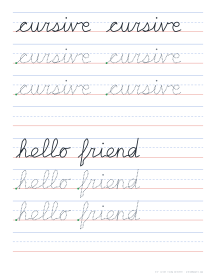
Joined handwriting from any words
Cursive is learned by tracing the movement until it is automatic: the lead-in from the baseline, the shape, and the exit stroke that carries the pen into the next letter. These sheets give that practice with your own words, from a child’s spelling list to a favourite quotation, rather than a fixed set of examples.
How each block works
- Model: the word in solid ink, to look at and copy.
- Trace: dotted rows to go over, with a green dot where the pen starts.
- Write alone: a blank set of lines at the end.
Short words repeat across the row; sentences print once per row. Switch the rows to all dotted, or to solid grey for tracing with a pen, in the settings.
About the letters
The alphabet was drawn for this site, letter by letter, so the joins between any two letters work. Each lowercase letter begins on the baseline and ends with an exit stroke; after o, b, v and w the join runs along the midline instead, as in most taught cursive styles. Tall letters (b, d, f, h, k, l, t) reach towards the top line, and g, j, p, q, y and the lower loop of f drop below the baseline. Capitals are printed and do not join.
Tips for cursive practice
- Start with single letters and short words, such as the cursive alphabet, before sentences.
- Keep the pencil on the paper through each word; lift only at the end of the word or for i dots and t crossings.
- Slant the paper slightly, to the left for right-handers and to the right for left-handers.
- Little and often: ten minutes a day builds the movement faster than a long weekly session.
For free writing once the letters are familiar, print cursive handwriting paper with slant guides, and for younger children start with name tracing in print letters.
Printing tips
Print at 100% on Letter or A4 so the letter height matches the setting. A sheet protector and a dry-wipe pen make a single copy reusable.
Popular cursive tracing worksheet sheets
Frequently asked questions
Can I make cursive worksheets from my own words?
Yes. Type one word, name or short sentence per line and each gets its own block of rows: a solid model to copy, dotted rows to trace and a blank row to write alone. Up to 12 lines per page.
Which cursive style is this?
An upright-friendly joined style with a gentle forward slant of about 9°, drawn for this site. Every lowercase letter starts on the baseline with a lead-in and ends with an exit stroke, so letters join without lifting the pencil. Letters such as o, b, v and w join from the midline.
Are capital letters joined?
No. Capitals are printed and stand on their own, and the next letter starts with its own lead-in. Many children find this easier than learning a separate set of looped cursive capitals.
What size should the letters be?
For children starting cursive, 3/4 inch (about 19 mm) from top line to baseline is comfortable; older children can move to 5/8 or 1/2 inch. Longer sentences need smaller letters to fit on a row.
What are the green dots?
Each green dot marks where the pen starts: once at the beginning of each joined word, and again at each capital. Joined letters are written without lifting, so there is only one start per word.
What happens if a sentence is too long?
It is shortened at the last word that fits, and the panel tells you. Choose a smaller letter height or split the sentence over two lines.
Last updated · About us