What prints with the starting settings
| Paper | US Letter — 215.9 × 279.4 mm (8.5 × 11 in) |
|---|---|
| Side length | 1″ |
| Shape size | 2″ × 1.732″ |
| Margins | 1/2″ |
| Line weight | 0.18 mm (bold 0.35 mm) |
| Print setting | Scale 100% / Actual size |
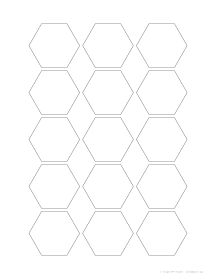
Paper pieces for precise patchwork
English paper piecing (EPP) wraps fabric around paper shapes, tacks it in place and whip-stitches the shapes together edge to edge. Because every shape is backed by an accurate paper template, the points meet precisely, which is why EPP is loved for hexagon “Grandmother’s Flower Garden” quilts, star blocks and travel-friendly hand sewing.
Choosing shapes and sizes
Shape. Hexagons are the classic; diamonds make stars and 3D tumbling blocks; jewels and half-hexagons add variety; tumblers create a striking pattern of alternating rows.
Side length. Presets from 1/2″ to 2″. Small shapes (1/2″ to 3/4″) give a delicate look and take longer; 1″ to 1 1/2″ is a common choice for a first project.
Seam allowance. Turn it on for cutting fabric; leave it off for the paper templates themselves.
How to piece
- Print and cut the paper shapes on the solid lines.
- Pin or glue each paper to the wrong side of the fabric and cut the fabric 1/4″ larger.
- Fold the fabric over the edges and tack or glue it down.
- Whip-stitch shapes together along their edges.
- Remove the papers once all sides are joined, and reuse them.
Printing tips
Print at 100% / Actual size on card. Check one side against a ruler before cutting a batch.
Popular EPP template sheets
Frequently asked questions
How are EPP shapes measured?
By the length of one side. A "1 inch hexagon" has six sides of 1 inch and measures 2 inches from point to point. The templates here use the same convention.
What does the seam allowance line do?
It draws a dashed outline 1/4″ outside each shape, the usual allowance for folding fabric over the paper. Cut the fabric on the dashed line and the paper on the solid line.
Which shapes are included?
Hexagons, 60° diamonds (which combine into six-pointed stars and tumbling blocks), jewels (elongated hexagons with two long sides), tumblers, half-hexagons and equilateral triangles.
What paper should I print on?
Card or heavy paper (around 160 to 200 g/m²) holds a crisp fold. Freezer paper works too if your printer accepts it.
Are the sizes accurate?
Yes, when printed at 100% / Actual size. Measure one side with a ruler before cutting a whole batch, and calibrate if your printer scales slightly.
Do the shapes tessellate on the page?
They are laid out in rows with a small gap for cutting, rather than touching, so each shape can be cut out cleanly.
Last updated · About us