Cross-stitch graph paper for every fabric count
Each setup opens the generator with the grid matched to one fabric count, enlarged so the squares are big enough to chart in. Change the cell size to true size (1:1) at any time to see the real stitch size.
11-count (beginners and kids)
Big 6.927 mm squares on a ×3 design grid, 26 × 36 stitches per Letter page. Each stitch is 2.309 mm on the fabric. Also fits 22-count Hardanger over two.
Use this setup PDF: US Letter · A4
14-count Aida (the standard)
The count most patterns and kits use. 5.443 mm squares on a ×3 design grid, 34 × 45 stitches per Letter page. Also fits 28-count evenweave over two.
Use this setup PDF: US Letter · A4
16-count (a step finer)
4.762 mm squares on a ×3 design grid, 39 × 52 stitches per Letter page, for more detail at the same finished size. Also fits 32-count linen over two.
Use this setup PDF: US Letter · A4
18-count (ornaments and miniatures)
4.233 mm squares on a ×3 design grid, 44 × 59 stitches per Letter page, which stitches up to about 2.4 × 3.3 inches, a typical ornament size.
Use this setup PDF: US Letter · A4
22-count (Hardanger over one)
3.464 mm squares on a ×3 design grid, 53 × 72 stitches per Letter page, for Hardanger over one thread, petit point detail and miniatures.
25-count (Lugana and evenweave over one)
3.048 mm squares on a ×3 design grid, 61 × 82 stitches per Letter page, for 25-count evenweave worked over one thread.
28-count (linen and evenweave over one)
2.721 mm squares on a ×3 design grid, 68 × 91 stitches per Letter page, for faces, small lettering and miniatures worked over one thread.
32-count (fine linen over one)
Enlarged ×4 so each 0.794 mm stitch becomes a 3.175 mm (1/8 inch) square, 58 × 78 stitches per Letter page, for heirloom samplers and tiny lettering.
What prints with the starting settings
| Paper | US Letter — 215.9 × 279.4 mm (8.5 × 11 in) |
|---|---|
| Stitches per inch | 14 |
| Cell size on paper | 3.629 mm (×2 of 1.814 mm) |
| Grid on this page | 51 × 68 stitches |
| Finished size of this grid | 3.643 × 4.857 in on 14-count |
| Margins | 1/2″ |
| Line weight | 0.15 mm (bold 0.4 mm) |
| Print setting | Scale 100% / Actual size |
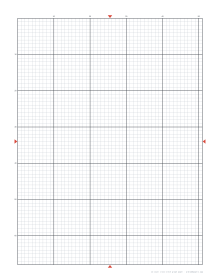
What cross-stitch graph paper is for
Every cross-stitch pattern is a grid in which each square stands for one stitch. Designing your own means drawing on that grid, coloring in squares, marking symbols for thread colors and counting out borders and lettering. Ordinary graph paper works in a pinch, but its squares don’t relate to any fabric. This generator ties the grid to the fabric count, so the page tells you exactly how big the finished piece will be.
Stitchers designing their own patterns use it to chart names, dates, monograms, pet portraits and small motifs for samplers and gifts. Teachers and craft group leaders print simple grids for beginners to color in before they pick up a needle. Pattern designers sketch ideas by hand before digitizing them, and people adapting a pattern to a different count use true-size grids to see how much smaller or larger it will stitch up.
Choosing the count and grid size
Start with the fabric you plan to stitch on, then pick the cell size. Each count has a ready-made setup above with an enlarged design grid; the page counts below are for that grid with half-inch margins on Letter and 10 mm margins on A4.
| Fabric count | Stitch size | Design grid | Square on paper | Stitches per page (Letter / A4) | Typical use |
|---|---|---|---|---|---|
| 11-count | 2.309 mm | ×3 | 6.927 mm | 26 × 36 / 26 × 39 | Beginners, children, bold designs |
| 14-count | 1.814 mm | ×3 | 5.443 mm | 34 × 45 / 34 × 50 | The all-round standard |
| 16-count | 1.588 mm | ×3 | 4.762 mm | 39 × 52 / 39 × 57 | More detail, still easy on the eyes |
| 18-count | 1.411 mm | ×3 | 4.233 mm | 44 × 59 / 43 × 64 | Ornaments, miniatures, fine shading |
| 22-count | 1.155 mm | ×3 | 3.464 mm | 53 × 72 / 53 × 78 | Hardanger over one, petit point |
| 25-count | 1.016 mm | ×3 | 3.048 mm | 61 × 82 / 61 × 89 | Lugana and evenweave over one |
| 28-count | 0.907 mm | ×3 | 2.721 mm | 68 × 91 / 68 × 100 | Linen and evenweave over one |
| 32-count | 0.794 mm | ×4 | 3.175 mm | 58 × 78 / 58 × 85 | Fine linen over one, heirloom samplers |
Every count from 11 to 28 fills a Letter page with roughly 2.4 × 3.3 inches of finished stitching on the ×3 grid, because the enlargement scales with the count. The 32-count grid is enlarged four times instead, so its page covers about 1.8 × 2.4 inches.
True size (1:1) previews the design at stitched scale; it is ideal for checking how a motif will look on a card, a tea towel or in a frame. For actual charting, ×2 or ×3 gives squares large enough to color with a pencil or fine marker, and ×4 suits children, anyone with low vision, and fine counts with single-stitch details. Our grid-by-count guide explains how count, stitch size and finished size relate.
11-count: big squares for beginners and kids
11-count Aida is the go-to fabric for children, first-time stitchers and anyone who finds smaller counts hard on the eyes. The weave is open, the holes are obvious, and schools, scout groups and craft clubs use it for first samplers, initials, simple animals and bookmarks. On the ×3 design grid each stitch is a 6.9 mm square that a young designer can color with a crayon, and 26 stitches across is a sensible width for a first motif. A design finishes noticeably larger than on 14-count: 44 stitches wide is 4 inches on 11-count and about 3.1 inches on 14-count.
For children, set Bold line every to 5: counting runs of five instead of ten reduces lost places. A good first chart is the child’s initial, about 15 stitches tall, with a simple border two squares outside it; on 11-count Aida it stitches up in an afternoon to a little under 2 inches tall. The same chunky grid suits large graphic designs meant to be seen from a distance, such as wall hangings, pennants and pixel-art characters, and a design that started as a fuse-bead project carries over from our bead pegboard templates, which use the same one-cell-per-color logic.
14-count: the standard for most patterns
14-count Aida is the fabric most published patterns and kits are designed for. Its holes are easy to see, a stitch is small enough to show reasonable detail, and two strands of floss fill each square nicely. If you are charting a pattern to share or sell, 14-count is the safe default because most stitchers own it already. The ×3 grid gives 5.443 mm squares, large enough to write a symbol in, and a page covers roughly a 2.4 × 3.2 inch area of stitching; the ×2 grid sits in between at 3.63 mm per square and fits 51 × 68 stitches.
If you are new to charting, start with a design of around 40 × 40 stitches that fits on one page, limit the palette to six or eight floss colors, and leave a line of empty squares around the motif as a border guide.
16-count: a step finer
16-count sits between the everyday 14-count and the fine 18-count. Stitchers choose it when a design needs more detail in the same finished size: a portrait with subtle shading, a sampler with small lettering, a floral piece with fine stems. A stitch is about 12% smaller than on 14-count, enough to make curves smoother and lettering crisper. An 80 × 100 stitch design finishes at 5 × 6.25 inches on 16-count, against about 5.7 × 7.1 inches on 14-count.
The ×2 cell size is a neat one on this count: doubling 1/16 inch gives exactly 1/8 inch (3.175 mm), so every eight squares on paper measure one inch on an ordinary ruler. Converting a 14-count pattern is simple: the stitch counts stay the same and only the finished size shrinks. To keep the original size instead, add roughly 8 stitches for every 56 in each direction, and use the extra space for smoother curves or more lettering.
18-count: ornaments, miniatures and fine detail
18-count Aida packs 324 stitches into every square inch, so it is the fabric of choice when a design must be small but detailed: Christmas ornaments, card inserts, bookmarks, jewelry and keyring inserts, miniature samplers and dollhouse pieces. It also suits larger pieces with fine shading, where the smaller stitch makes color blends look smooth. A design finishes about 22% smaller than the same chart on 14-count.
For ornaments, decide the finished size first and work backward: a 3-inch round ornament is 54 stitches across. Mark that boundary on the grid and design inside it, leaving a stitch or two for the edge finish. For a matched set, chart each motif (a star, a bell, a tree) inside the same square boundary, so you can cut backing felt or card in one batch. Switch to the ×4 cell size, 5.644 mm squares, when a design relies on single-stitch details such as eyes and highlights, or on many similar shades.
Fine counts: 22- to 32-count over one
The higher counts are mostly evenweave and linen, where threads are counted individually. Most stitchers work these fabrics over two threads, which halves the count, and use over one for fine detail: faces and hands in an otherwise over-two figure, dates and initials on samplers, miniatures, jewelry inserts and petit point effects. The setups for 22 to 32 are drawn for over one; for over two, use the matching lower count.
| Fabric | Over one | Over two | Chart over two on |
|---|---|---|---|
| 22-count Hardanger | 22 per inch | 11 per inch | 11-count grid |
| 25-count evenweave (Lugana) | 25 per inch | 12.5 per inch | any grid; divide by 12.5 for finished size |
| 28-count evenweave or linen | 28 per inch | 14 per inch | 14-count grid |
| 32-count linen | 32 per inch | 16 per inch | 16-count grid |
| 36-count linen | 36 per inch | 18 per inch | 18-count grid |
22-count Hardanger. Hardanger has 22 pairs of threads per inch; over one it gives 22 stitches per inch, a favorite for miniatures, jewelry inserts, bookmarks and dollhouse samplers. A single strand of floss is usual. A design 110 stitches wide finishes at 5 inches, and 66 stitches at 3 inches. If you want the finished piece a little larger, compare the same chart on 18-count.
25-count Lugana and evenweave. A soft, even fabric popular for samplers and heirloom pieces. Over two it gives 12.5 stitches per inch, the more common choice; over one it gives 25, for faces, lettering and miniatures. Divide the stitch count by 25 for inches over one, or by 12.5 over two.
28-count linen and evenweave. Among the most popular fabrics for counted work. Over two it matches 14-count Aida; over one it doubles the resolution to 28 stitches per inch. A 140-stitch design is 5 inches wide over one and 10 inches over two.
32-count linen. The classic fabric for fine samplers and heirloom pieces. Over one, each stitch is only about 0.8 mm, so the setup enlarges the grid four times to 3.175 mm squares. A 100-stitch design is about 3 1/8 inches over one, or 6 1/4 inches over two. Use a single strand of floss, or silk for extra fineness, and keep over-one areas small, since whole designs over one take a long time.
At any of these counts, good light and a magnifier make a real difference, and marking the bold ten-stitch lines on the fabric with a removable thread helps you keep your place. For thread quantities, see the thread guide on CraftPatterns.
Charting tips
- Sketch the outline first in pencil, then decide which squares are in or out. Diagonal edges look smoother if you stagger the steps evenly.
- Use colored pencils for a color chart, or a symbol in each square for a black-and-white chart that photocopies well, and keep a key of symbols beside the chart.
- Start from the center arrows so the design is balanced on the fabric; for borders and repeating bands, which are counted from one end, switch the arrows off.
- Chart lettering on a scrap grid first and stitch-count each word; the bold ten-stitch blocks make it quick to center a line of text.
- When the chart is done, add up the stitches in both directions, divide by the count, and add at least 2–3 inches (5–8 cm) of fabric on every side for framing; on 14-count that is about 28–42 stitches on each side. Write the fabric size beside the chart.
If you are starting from a photo rather than a drawing, our sister site CraftPatterns converts images into stitchable patterns and has charts ready to stitch.
Setting it up in the generator
Choose Cross-stitch graph paper as the paper type, then the fabric count (11 to 32) and cell size. Set how often bold lines appear, and switch the edge numbering and center arrows on or off. The spec table shows the stitch size on paper, how many stitches fit, and the finished size of the whole grid on your fabric. Landscape orientation suits wide designs such as borders and bookmarks.
Under Advanced options, you can make the minor lines lighter so colored squares stand out, add a title such as the pattern name, and set Pages in the PDF for a large chart that spans several sheets, or to print a set for a class, one sheet per student. Multi-page charts tape together neatly along the bold lines.
Printing tips
At true size, accuracy matters: print at Actual size (100%) and measure ten stitches with a ruler. Ten squares of a true-size grid should span 254 mm divided by the count:
| Count | 11 | 14 | 16 | 18 | 22 | 25 | 28 | 32 |
|---|---|---|---|---|---|---|---|---|
| Ten squares at true size | 23.09 mm | 18.14 mm | 15.88 mm | 14.11 mm | 11.55 mm | 10.16 mm | 9.07 mm | 7.94 mm |
If the grid is off, use the printer calibration once. For enlarged design grids, small scaling errors don’t affect your chart, but true scale keeps finished-size estimates honest, and you can lay a true-size print over a fabric scrap to check its count. Very fine true-size lines print best on a laser printer or an inkjet in standard quality. A bright white paper makes colored-pencil charts easiest to read under a lamp while you stitch.
Frequently asked questions
What does fabric count mean in cross-stitch?
Count is the number of stitches per inch. On 14-count Aida, the most common beginner fabric, you make 14 cross-stitches in every inch, so each stitch is 1.814 mm wide. Higher counts mean smaller stitches and finer detail; lower counts mean bigger stitches that are easier to see. Pick the grid by the number of stitches per inch you will actually make, which on evenweave and linen depends on whether you stitch over one thread or over two.
What is the difference between true size and a design grid?
At true size (1:1) each square on paper is exactly one stitch on your fabric, so the printed grid shows the real finished size of the design. That is useful for checking proportions, but 14-count squares are under 2 mm, too small to draw in comfortably. A design grid ×2, ×3 or ×4 enlarges every square for charting while keeping the count, so the spec table can still tell you the finished size.
How big will my design be when stitched?
Divide the number of stitches by the fabric count. A design 70 stitches wide on 14-count Aida finishes at 5 inches; on 18-count it is just under 4 inches, and on 11-count a little over 6 inches. The spec table above shows the finished size of the full grid on the page for your chosen count.
How many stitches fit on one page?
It depends on the count and the enlargement. With the default ×2 design grid for 14-count, a Letter page holds 51 × 68 stitches; on the ×3 grid it holds 34 × 45. At true size, the same page holds 102 × 137 stitches of 14-count. The table by count lists every count, and larger designs can be charted across several pages, using the bold ten-stitch lines to match them up.
Which grid do I use for evenweave or linen over two?
How many strands of floss should I use?
As a starting point for six-strand cotton floss: three strands on 11-count (two for a lighter look), two on 14-count and 16-count, two or one on 18-count, and a single strand on 22-count and finer, where silk also works on 32-count linen. Backstitch outlines are usually one strand. Threads cover differently, so stitch a small test patch first.
Why is 11-count Aida good for beginners?
The holes are bigger and farther apart than on 14-count, so they are easy to see and to hit with a blunt tapestry needle. Each stitch is about 2.3 mm, which forgives slightly uneven tension, and mistakes are easier to unpick. The 11-count setup prints big squares children can color with crayons or felt-tips.
What size ornament does a page of 18-count grid make?
A full Letter page of the ×3 grid, 44 × 59 stitches, finishes at about 2.4 × 3.3 inches on 18-count, a typical size for a tree ornament or small framed piece. To work backward from a size, multiply by the count: a 3-inch round ornament is 54 stitches across.
Why are the fine counts enlarged three or four times?
What are the red arrows on the edges?
They mark the center of the grid horizontally and vertically. Most patterns start stitching from the center of the fabric so the design is centered when framed. Fold your fabric in quarters to find its middle, then match it to the point where the arrows meet. For borders and repeating bands, which are counted from one end, you can switch the arrows off.
Why are the bold lines every 10 stitches?
Counting is the hardest part of cross-stitch, and blocks of ten make it much easier to keep your place. Most published charts use the same convention, and the numbering along the edges counts in tens as well. You can change the interval under Bold line every; runs of five help children keep count.
Last updated · About us