What prints with the starting settings
| Paper | US Letter — 215.9 × 279.4 mm (8.5 × 11 in) |
|---|---|
| Pegs | 5 × 5 per board |
| Boards per page | 6 |
| Margins | 1/2″ |
| Line weight | 0.18 mm (bold 0.35 mm) |
| Print setting | Scale 100% / Actual size |
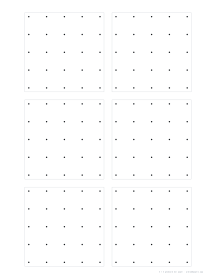
Geoboards on paper
A geoboard is a square board of pegs on which children stretch rubber bands into shapes. It is one of the most hands-on ways to explore polygons, area, perimeter, symmetry and fractions of shapes. Recording sheets with matching dot arrays let children keep a copy of what they made, compare answers and continue the work away from the boards.
Choosing a layout
Pick the peg count that matches your boards: 5 × 5 for most primary work, 7 × 7 or 11 × 11 for larger shapes and area problems. Six boards per page gives each child space to record several shapes; nine or twelve suits quick “how many different ways?” investigations.
Activity ideas
- Make every different triangle on a 3 × 3 section of the board and record each one.
- Make a shape with an area of four squares in as many ways as possible.
- Draw a line of symmetry and complete the mirror image.
- Show a half, a quarter and an eighth of the whole board.
Printing tips
Print at 100% / Actual size. The dots are solid and dark, so the sheets photocopy well for a whole class.
Popular geoboard dot paper sheets
Frequently asked questions
Which geoboard size should I choose?
Match the boards in your classroom. The common sizes are 5 × 5 pegs, the standard small board, plus larger 7 × 7 and 11 × 11 boards for more complex shapes and area work.
How many boards fit on a page?
Four, six, nine or twelve. Six is a good default for "make and record" activities where each child records several shapes.
Are the dots spaced like a real geoboard?
The dots are in the same square arrangement as the pegs, scaled to fit the page. The spacing is not the physical peg spacing, so shapes are drawn as a scaled copy.
What can children do with geoboard dot paper?
Record shapes made on a geoboard, find the area of shapes by counting squares, draw all the different triangles possible on a 3 × 3 square, explore symmetry and copy shapes from a card.
Can I use it without a geoboard?
Yes. Drawing straight lines between dots is a geoboard activity on paper, and works well for homework when physical boards are not available.
Is there isometric dot paper too?
Yes, see isometric dot paper for triangular arrays used in 3D drawing.
Last updated · About us