Blank hundreds chart and 0–99 chart
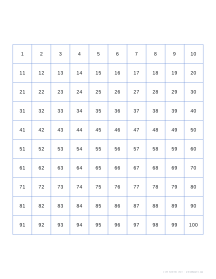
The complete 1 to 100 chart is the default above. These two setups print an empty chart for children to fill in, or a 0 to 99 chart for place value.
Blank hundreds chart (empty 100 chart)
An empty ten-by-ten grid for children to write the numbers 1 to 100 themselves. With one chart per page each square is a little under 2 cm across; choose two or four per page to save paper.
Use this setup PDF: US Letter · A4
0–99 chart (place value)
The numbers 0 to 99 in ten rows of ten, each row starting with a multiple of ten, so the row gives the tens digit and the column gives the ones digit.
What prints with the starting settings
| Paper | US Letter — 215.9 × 279.4 mm (8.5 × 11 in) |
|---|---|
| Numbers | 1 to 100 |
| Charts per page | 1 |
| Margins | 1/2″ |
| Line weight | 0.18 mm (bold 0.35 mm) |
| Print setting | Scale 100% / Actual size |
Why the hundreds chart is so useful
A hundreds chart lays the first hundred numbers out in rows of ten, which makes the structure of our number system visible. Moving one square right adds one; moving one square down adds ten. Children use it to count on, count back, find ten more and ten less, spot odd and even numbers, and colour in multiples to discover times-table patterns.
Choosing a version
| Version | What prints | Best for |
|---|---|---|
| Complete 1–100 | Every number, rows starting 1, 11, 21… | Early counting, a wall or folder reference |
| 0–99 | Every number, rows starting 0, 10, 20… | Place value, tens and ones |
| 1–120 | Twelve rows of ten | Counting beyond 100 |
| Blank | The empty grid | Writing the numbers out, skip counting |
| Missing numbers | About 40% of the numbers removed | Pattern puzzles, a new set of gaps every time |
0–99 chart: place value made visible
The 0–99 chart arranges numbers so that each row is one tens value and each column one ones value. 47 is in the “40” row and the “7” column; 70 starts its own row. Moving down a column adds ten without changing the ones digit, and the pattern never breaks at the end of a row the way it does on a 1–100 chart, where 10, 20 and 30 sit at the right-hand edge.
- Tens and ones: point to a number and say how many tens and ones it has.
- Add ten, take ten: move up or down from any number.
- Digit patterns: colour every number whose digits add to 9 and describe the diagonal.
Children who are confident on the 0–99 chart are ready for numbers beyond 100: the 120 chart extends the same idea, and the 0–100 number line shows the numbers in one line.
Blank hundreds chart: filling it in from scratch
Writing out a hundreds chart is slow, and that is the point. Children have to keep count for a long stretch, notice when a row ends, and discover that every number in a column ends in the same digit. Teachers often spread it across a week: the first ten rows on Monday, checked against a complete chart, and so on until the grid is full.
The blank grid is not only for writing 1 to 100 in order:
- Skip counting: write only the multiples of 2, 5 or 10 and leave the other squares empty. The pattern of filled squares shows the times table.
- Start anywhere: give a starting number in a random square and ask the child to fill outwards in every direction.
- Odd and even: colour the odd squares one colour as they are written.
- Partner check: two children fill charts at the same time and compare columns at the end.
One chart per page gives the largest squares for early writers. Two per page suits older children and saves paper. For a puzzle rather than a full write-out, the missing numbers chart leaves only some gaps.
Activity ideas
- Colour every multiple of 2, 5 or 10 and describe the pattern that appears.
- Cover a number with a counter; ask what is ten more, ten less, one more and one less.
- Cut a complete chart into pieces and reassemble it like a jigsaw.
- Give each child a different “Some missing” puzzle by changing the puzzle number.
Printing tips
Print at 100% / Actual size. For laminated reusable charts, print one chart per page on card: a laminated complete chart makes a desk reference, and laminated blank charts work well with dry-wipe pens for daily practice. Four charts per page saves paper for colouring activities.
Popular hundreds chart sheets
Frequently asked questions
What is the difference between a 1–100 and a 0–99 chart?
A 1–100 chart starts each row with a number ending in 1 (1, 11, 21…), which matches how children count. A 0–99 chart starts each row with a multiple of ten (0, 10, 20…), so every number in a column shares its ones digit and every number in a row shares its tens digit. Many teachers prefer it for place value and for older children, because the tens change exactly at the start of each row.
Why use a 1–120 chart?
Many early maths curricula ask children to count past 100. The 1–120 chart adds two rows so the pattern continues into the hundreds.
What does "Some missing" do?
About 40 percent of the numbers are left out at random, so children fill in the gaps using the patterns along rows and columns. Change the Puzzle number for a different set of gaps; the same number always gives the same chart.
Can I print a blank hundreds chart?
Yes. The blank hundreds chart is an empty 10 × 10 grid that children fill in themselves, also useful for colouring patterns. For a blank 0 to 99 or 1 to 120 chart, choose that range in the generator and set Numbers shown to None (blank).
How do children use a blank hundreds chart?
They write the numbers in order, starting with 1 in the top-left square and filling each row of ten before moving down. Finishing the chart takes practice with counting, writing digits and spotting the pattern in each column.
Is there an answer key for the blank chart?
Yes: the complete 1 to 100 chart, the default on this page, is the answer key for every blank chart. Print one alongside the blank sheets.
How many charts fit on a page?
One, two or four. Two per page suits homework and morning work; four small charts per page work well for pattern colouring activities where each chart shows a different times table.
Are the squares large enough for counters?
On one chart per page, the squares are about 1.9 cm (3/4 inch) on Letter and A4, large enough for small counters and for young children's handwriting. Four charts per page makes squares about 9 mm, better for colouring than writing.
Last updated · About us