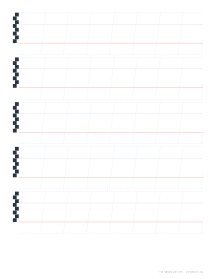
The lines on a guide sheet
Most guide sheets have four kinds of line:
- Baseline: where letters sit.
- Waistline (x-height line): the top of small letters such as a, e, n and x.
- Ascender line: the top of tall letters such as b, d, h and l.
- Descender line: the bottom of letters such as g, p and y.
The distance from baseline to waistline is the x-height, and it sets the proportions of the whole hand. Slanted hands also have slant lines crossing the writing lines at the hand’s angle, to keep every downstroke parallel.
Broad-edged hands: measuring in nib widths
With a broad-edged pen (a chisel-shaped nib), the thickness of strokes depends on the nib width, so letter heights are measured in nib widths too. A nib ladder at the start of each line shows the measurement: small squares made with the pen held flat, stacked like steps. Change the nib and the guide should change with it, which is why printing your own guide at the right size is useful.
| Hand | X-height | Ascenders / descenders | Slant |
|---|---|---|---|
| Foundational | 4 nib widths | about 3 more | upright |
| Italic | 5 nib widths | about 3 more | 5–10° from upright |
| Blackletter (Textura) | 5 nib widths | about 2 more | upright |
| Uncial | about 3.5 nib widths | short, about 1.5 | upright |
These are typical teaching proportions; different teachers and historical models vary a little. Because the heights are counted in nib widths, the same hand comes out very different sizes with different nibs:
| Hand | 2 mm nib | 3 mm nib | 3.8 mm nib | 5 mm nib |
|---|---|---|---|---|
| Foundational | 8.0 mm · 20 mm total | 12.0 mm · 30 mm total | 15.2 mm · 38 mm total | 20.0 mm · 50 mm total |
| Italic | 10.0 mm · 22 mm total | 15.0 mm · 33 mm total | 19.0 mm · 42 mm total | 25.0 mm · 55 mm total |
| Blackletter (Textura) | 10.0 mm · 18 mm total | 15.0 mm · 27 mm total | 19.0 mm · 34 mm total | 25.0 mm · 45 mm total |
| Uncial | 7.0 mm · 13 mm total | 10.5 mm · 20 mm total | 13.3 mm · 25 mm total | 17.5 mm · 33 mm total |
Each cell shows the x-height, then the full height from descender line to ascender line, before any gap between lines. In the calligraphy paper generator, choose the hand and your nib width and the sheet draws the matching lines and nib ladder.
Here is what the guide sheets look like, each at its default nib width:
- Foundationalupright, 4 nib widths
- Italicslanted, 5 nib widths
- Blackletterupright, 5 nib widths
- Copperplate55° slant, 2:1:2
Pointed-pen hands: ratios and slant
Pointed-pen scripts such as Copperplate and Spencerian make thick and thin strokes by pressure, not nib shape, so they are measured as ratios of the x-height instead of nib widths. A common Copperplate ratio is 2:1:2: ascenders twice the x-height, the x-height, and descenders twice the x-height. Copperplate is usually written at a slant of about 55° from horizontal and Spencerian at about 52°, the conventional figures also listed in Wikipedia’s table of handwriting slants, with slant lines printed across the sheet. Some guide makers state the angle from vertical instead (35° and 38°), which describes the same slant. Many beginners use a larger x-height at first, then shrink it as their control improves.
Choosing the size
- Bigger is easier to learn. Larger letters show mistakes clearly and train arm movement rather than finger movement.
- Match the nib. For broad-edged pens, measure your nib or use its listed width, then print the guide for that width.
- Brush lettering uses three or four lines with a generous x-height; brush lettering paper has a pre-set layout for brush pens.
Practising well
- Start with drills: downstrokes, upstrokes, ovals and the basic shapes the hand is built from.
- Practise letter families that share strokes (for example n, m, h, r in Italic).
- Keep the slant consistent by checking every downstroke against a slant line.
- Write whole words early, because spacing between letters is half of good calligraphy.
- Put the guide sheet under a sheet of smooth layout paper once you are confident, so your practice looks like a finished piece.
Paper and ink tips
Smooth paper of 90 to 120 gsm keeps fine hairlines crisp and stops ink feathering. Copy paper is fine for drills, but a pointed nib can catch on its surface; a smoother laser paper or a calligraphy pad gives better hairlines. If ink bleeds, try a heavier or coated paper, or a thicker ink.