What prints with the starting settings
| Paper | US Letter — 215.9 × 279.4 mm (8.5 × 11 in) |
|---|---|
| Letter height | 1″ (x-height 1/2″) |
| Rows on this page | 6 |
| Words | 1 |
| Margins | 1/2″ |
| Line weight | 0.25 mm (bold 0.35 mm) |
| Print setting | Scale 100% / Actual size |
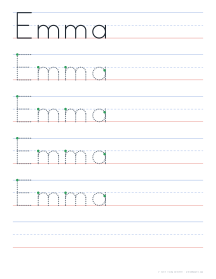
Practice writing the word that matters most
A child’s own name is usually the first word they learn to write, and the one they care about most. This maker turns any name into a tracing sheet in a few seconds. The letters are dotted so they can be traced with a pencil or crayon, sit on proper three-line handwriting rows so children learn where each letter belongs, and start with a green dot so every letter begins in the right place.
How the page is laid out
Each row is a handwriting set: a solid top line, a dashed midline and a red baseline. Capitals and tall letters reach the top line; small letters like a, e and o fill the space between the midline and the baseline; and g, j, p, q and y drop below the baseline into the space before the next row.
With the default Model, trace, then write alone layout, each word gets a block of rows. The first shows the word in solid letters, the middle rows are dotted, and the last is empty for writing without help. You can switch to All dotted for pure tracing practice, or All grey for solid light letters that some children find easier to follow with a crayon.
Repeat across each row fills the row with as many copies as fit, so short names get extra practice on every line.
Several names on one sheet
Type names separated by commas or on new lines, up to twelve. The page is shared between them, which is useful for siblings, small groups or a class name chart. For a full class, make one sheet per child with a single name each: the bigger the share of the page, the more practice rows each name gets.
Beyond names
The same tool works for any short words: spelling lists, sight words, days of the week, numbers 0 to 9, or a simple sentence. Letters and numbers are supported, along with basic punctuation (full stops, hyphens, apostrophes, question and exclamation marks). Other characters are left as spaces.
Letter size and age
- 1 1/4 inch or 1 inch: preschool and kindergarten, first pencil grip, chunky crayons.
- 3/4 inch: late kindergarten and first grade.
- 5/8 inch: second grade and older children refining their letters.
If a word is too long to fit one row at the chosen size, the spec table below the preview says so, and the letters that fit are traced; choose a smaller size to fit the whole word.
Tips for tracing practice
Short sessions work best: one or two rows at a time, then praise. Encourage children to start at the green dot and trace without lifting the pencil where a letter allows. Laminate a sheet or slip it into a plastic sleeve for dry-wipe practice, and move on to kindergarten handwriting paper once the name can be written from memory.
Printing
Print at 100% / Actual size on Letter or A4 so the letters and lines keep their true heights. Bright white paper and a dark printer setting make the dots easy to see.
Popular name tracing worksheet sheets
Frequently asked questions
How do I make a name tracing worksheet?
Type the name in the box above, choose a letter size, and download the PDF. Type several names separated by commas or on separate lines to share the page between them, which is handy for a class set.
What letter style is used?
A simple ball-and-stick manuscript print: straight lines and round curves, with tall letters reaching the top line, small letters reaching the dashed midline, and tails dropping below the baseline. It was drawn for this site, so the dots follow the strokes children are taught.
What are the green dots?
The starting point of each letter. Beginning every letter at the green dot, and following the strokes in order, builds the correct habits from the start: most letters begin at the top.
What does "Model, trace, then write alone" mean?
Each word gets a group of rows. The first row shows the word in solid letters to look at, the middle rows are dotted for tracing, and the last row is left empty for writing the word unaided.
Which letter size should I choose?
1 1/4 inch for preschool and children just starting to hold a pencil; 1 inch for kindergarten; 3/4 inch for late kindergarten and first grade; 5/8 inch for older children. Larger letters mean fewer rows per page.
Can I use capitals only?
Yes. Letters are drawn exactly as typed, so type the name in capitals for an all-capitals sheet, or with one capital for the usual name form.
Last updated · About us