What prints with the starting settings
| Paper | US Letter — 215.9 × 279.4 mm (8.5 × 11 in) |
|---|---|
| Clues | 110 of 369 squares |
| Solving | Unique solution; scanning for singles is enough, no guessing |
| Margins | 1/2″ |
| Line weight | 0.18 mm (bold 0.35 mm) |
| Print setting | Scale 100% / Actual size |
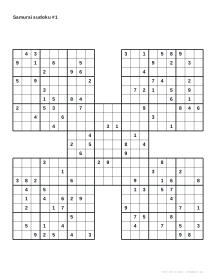
Five puzzles in one
Samurai sudoku, also called gattai-5, joins five grids into one large puzzle. The four corner grids each share a 3 × 3 box with the grid in the middle, so progress anywhere can spread across the whole board. It is a longer, more satisfying solve than a single sudoku: an evening rather than a coffee break.
How these puzzles are made
Each puzzle starts from a complete, valid five-grid solution. Clues are then taken away in pairs, symmetrically about the centre, and after each removal the puzzle is checked by a solver that uses only the two most basic techniques: a square where only one digit fits, and a digit that fits in only one square of a row, column or box. If that solver can no longer finish the grid, the clues go back. The result always has exactly one solution and never needs a guess.
Solving tips
- Start where the clues are dense, often a corner grid.
- Work the shared boxes from both sides. A digit missing from a shared box must fit the rows and columns of both grids, which narrows it down quickly.
- Pencil in small candidates in the shared boxes; they are the bridges between grids.
- Check each grid as you finish it, before moving on, since an error in a shared box spreads into two grids.
Our guide on how to solve sudoku explains scanning and the other techniques step by step, and the sudoku generator makes single-grid puzzles at three levels.
Printing tips
Print at 100% on Letter or A4. The board fills the page with squares about 9 mm across; the answer page is page 2 of the PDF, so print page 1 alone if you do not want to see the solution.
Frequently asked questions
What is a samurai sudoku?
Five standard 9 × 9 sudoku grids arranged in an X, with the centre grid overlapping each corner grid by one 3 × 3 box. Every row, column and box of each grid must contain 1 to 9, and the shared boxes must work for both grids at once.
How many squares does it have?
- Five grids of 81 squares would be 405, but the four shared boxes of 9 squares are counted once, which removes 36.
Where should I start?
Usually in a corner grid with the most clues, or in a shared box: a digit placed there counts for two grids at once, which often unlocks the centre.
Can each grid be solved on its own?
Not always. A samurai puzzle only needs a unique solution as a whole, so a grid may need digits from the shared boxes before it can be finished. That cross-over is what makes the format interesting.
How hard are these puzzles?
Every puzzle can be finished by scanning for singles, where only one digit fits a square or a digit fits only one square in a row, column or box, so no guessing or advanced technique is needed. Easy leaves about 170 clues; medium removes clues until no more can go without breaking that rule, typically 100 to 115.
Last updated · About us