Multiplication chart 1–10
The ten times tables most children learn first, in one grid. The default above is the full 1 to 12 chart.
Multiplication chart 1–10 (10 × 10)
Every product from 1 × 1 to 10 × 10, 100 in all, with shaded factor headings and larger squares than the 12 × 12 chart. Choose four per page for small cards to glue into exercise books.
Use this setup PDF: US Letter · A4
What prints with the starting settings
| Paper | US Letter — 215.9 × 279.4 mm (8.5 × 11 in) |
|---|---|
| Grid | 12 × 12 (144 products) |
| Grids per page | 1 |
| Margins | 1/2″ |
| Line weight | 0.18 mm (bold 0.35 mm) |
| Print setting | Scale 100% / Actual size |
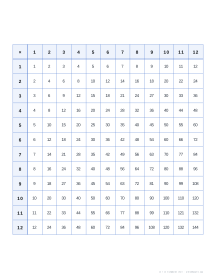
A grid that shows how multiplication works
The multiplication chart is more than a lookup table. Its rows are the times tables, its diagonal holds the square numbers, and the grid is symmetrical across that diagonal because 3 × 7 and 7 × 3 are the same product. Spotting these patterns helps children memorise facts with understanding rather than by rote.
A reference chart also lets children check a fact quickly while they work on harder problems, such as long multiplication or fractions, so one missing fact does not stop the whole calculation.
Choosing a size
| Chart | Products | Good for |
|---|---|---|
| 5 × 5 | 25 | A first chart for the 1s to 5s |
| 1–10 (10 × 10) | 100 | The tables most children learn first; larger squares, less to scan |
| 1–12 (12 × 12) | 144 | Schools that teach times tables to 12 × 12 |
Multiplication chart 1–10
With only ten rows, the 1–10 chart has bigger squares and less to scan than a 12 × 12 grid, which makes it friendlier for younger pupils. It covers every fact from 1 × 1 to 10 × 10, and it is the natural chart to keep on the desk while the first ten tables are being learned.
Choosing a version
Reference chart. A complete 12 × 12 or 10 × 10 grid to keep in a folder or on the wall while facts are being learned.
Blank grid. The headers are printed but the products are left for the learner to fill in, which works as both practice and a check. See the blank multiplication chart.
Practice with gaps. About half of the products are missing at random. Because each puzzle number gives a different set of gaps, you can give a class the same sheet or a different one to each student. See multiplication chart practice.
Start with the full chart on the desk, then move to the blank grid as facts become secure.
Patterns to point out
- The 10s column is the counting number with a zero on the end.
- The 5s alternate between endings of 5 and 0.
- The 9s digits add up to 9 (18, 27, 36…), and the tens digit is one less than the number being multiplied.
- Square numbers run down the diagonal: 1, 4, 9, 16, 25…
- Symmetry along the diagonal means every fact has a partner: 4 × 7 = 7 × 4.
Ideas for practice
- Highlight the square numbers on the diagonal and talk about why they are there.
- Colour one table at a time and notice the patterns in the last digits.
- Fold the chart along the diagonal to show that the two halves match.
- Time a blank 10 × 10 grid once a week and track the improvement.
- Colour multiples on a hundreds chart to see the same tables as a pattern.
The times tables guide suggests an order for learning the tables and a practice plan.
Printing tips
Print at 100% / Actual size. A single chart per page gives squares large enough for young handwriting; two or four per page are better as quick references. For a desk card that lasts, print on card and laminate it.
Popular multiplication chart sheets
Frequently asked questions
Should I use a 10 × 10 or a 12 × 12 chart?
Use the size your curriculum expects children to know. Many schools teach the 1 to 10 tables first and add 11 and 12 later; others stop at 10 × 10. The 1–10 chart has 100 products instead of 144, so its squares are larger. A 5 × 5 chart is a gentle start for the 1 to 5 tables.
How do I read a multiplication chart?
Find one factor in the shaded top row and the other in the shaded left column; the product is where that row and column meet. For 6 × 8, follow row 6 across to column 8: 48.
How does the practice version work?
Some missing leaves about half of the products blank at random. Children fill them in, using facts they know and patterns in the grid. Change the Puzzle number for a fresh sheet; the same number always gives the same gaps, so a whole class can work on an identical sheet.
What is a blank multiplication chart for?
Filling in an empty grid from memory is a classic times-table exercise and a quick check of which facts are secure. Timed versions make a good weekly challenge. The blank multiplication chart has the 12 × 12 grid ready; set Up to to 10 × 10 for a smaller one.
Can I print several small charts on one page?
Yes, two or four per page. Four per page, cut into quarters, makes small reference charts for a pencil case, a maths book or a folder; each chart is still readable.
What patterns can children find on the chart?
The square numbers run down the diagonal, and the grid is symmetrical across it because 4 × 7 and 7 × 4 are the same. The 10s end in zero, the 5s alternate between endings of 5 and 0, and the digits of each 9s product add up to 9.
Why is the chart shaded?
The top row and left column, which hold the numbers being multiplied, have a light tint so children can trace along a row and down a column to find each product.
Will it print well in black and white?
Yes. The tint is very light and all numbers are dark, so it photocopies cleanly.
Last updated · About us