What prints with the starting settings
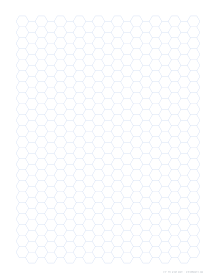
| Paper | US Letter — 215.9 × 279.4 mm (8.5 × 11 in) |
|---|---|
| Hexagon side | 6.35 mm = 1/4″ |
| Across flats | 0.433″ |
| Across corners | 1/2″ |
| Margins | 1/2″ |
| Line weight | 0.18 mm (bold 0.35 mm) |
| Print setting | Scale 100% / Actual size |
Standard hexagon side
| Hexagon side | Millimetres | Inches | Per inch | Grid on Letter | Grid on A4 |
|---|---|---|---|---|---|
| 3 mm | 3 mm | 0.118″ | 8.47 | 63 × 84 | 63 × 92 |
| 5 mm | 5 mm | 0.197″ | 5.08 | 38 × 50 | 38 × 55 |
| 8 mm | 8 mm | 0.315″ | 3.18 | 23 × 31 | 23 × 34 |
| 10 mm | 10 mm | 0.394″ | 2.54 | 19 × 25 | 19 × 27 |
| 1/4″ | 6.35 mm | 0.25″ | 4 | 30 × 40 | 29 × 43 |
| 1/2″ | 12.7 mm | 0.5″ | 2 | 15 × 20 | 14 × 21 |
| 1″ across | 14.66 mm | 0.577″ | 1.73 | 12 × 17 | 12 × 18 |
| 1″ | 25.4 mm | 1″ | 1 | 7 × 10 | 7 × 10 |
What hexagonal paper is used for
A hexagon has six neighbors, all the same distance away. That simple property makes hex grids the favorite of anyone who needs fair movement or tight packing on a flat surface.
Tabletop gamers and game designers draw overland maps, battle maps and board game prototypes on hex paper because movement in any of six directions costs the same. Chemistry students use it to sketch ring structures. Quilters print hexagon templates for English paper piecing. Teachers use it for tessellation lessons, area problems and honeycomb nature studies. Designers and illustrators build tile patterns, logos and backgrounds from it, and some bead and crochet crafters plan circular motifs on it.
Choosing the hex size
The generator sizes hexes by side length, and shows the across-flats and across-corners measurements in the spec table so you can match whichever one your project uses.
- 1 inch across flats (side 14.66 mm) — the tabletop miniatures standard, 5 feet per hex. Choose the 1″ across preset.
- 1/4 inch side (about 0.43 inch across flats) — the default here. A good general-purpose grid for overland maps and sketching.
- 5 mm side — compact hexes for chemistry, dense hex-crawl maps and A4 pages. See 5 mm hex paper.
- 1/2 inch to 1 inch side — quilting templates, classroom tessellations and large hex tiles.
For hex-crawl adventures, a common approach is a small grid for the region map and a 1 inch across flats grid for encounters. Our tabletop map scales guide explains how the scales relate.
Flat-top or pointy-top
Orientation changes which way the straight lines of hexes run. Flat-top grids have vertical columns, which suits maps you number by column and row. Pointy-top grids have horizontal rows, which reads more naturally if you write labels inside each hex or plan bead and stitch patterns in rows. If you are copying an existing map, look at the top edge of a single hex: flat or a point.
Tips for hex maps and patterns
- Number the hexes lightly in pencil before you start drawing terrain, so you can reference locations in notes.
- Use a pale gray or blue line color so terrain, roads and rivers stand out on top.
- For a campaign map larger than one sheet, print several pages with the same settings and trim the margins; the hex sizes stay identical from page to page.
- For card stock templates, increase the line weight slightly so cut lines are easy to follow.
Setting it up in the generator
Choose Hexagonal paper as the paper type, then the paper size. Pick a side length from the presets, or type a custom value in millimeters or inches. Switch between flat-top and pointy-top under the paper settings. Turn on True size in the preview to check the hexes against a real game piece or template held up to the screen.
In Advanced options you can change line color, line weight and dash style, add a title such as a map name, and set the number of pages. Export SVG if you want to bring the grid into a drawing app as a background, or a transparent PNG to overlay it on a scanned map.
Printing tips
Print at Actual size (100%). Game maps in particular need true scale, otherwise a 1 inch base no longer fits a hex; a page printed with Fit to page shrinks each hex by several percent. Measure across flats on one hex with a ruler after the first print and run the printer calibration if it is off.
For maps that will be handled a lot, print on heavier paper or card and consider laminating. A wet-erase marker on a laminated hex sheet makes a reusable battle map.
Popular hex graph paper sheets
Frequently asked questions
How is hexagon size measured?
Three ways, and it matters which one a pattern or game uses. Side length is the length of one edge. Across flats is the distance between two opposite parallel sides, which is 1.732 times the side. Across corners is the distance between opposite points, exactly twice the side. The spec table above shows all three for the size you choose.
What hex size do tabletop games use?
Hex maps for miniatures games are usually 1 inch across flats, with each hex representing 5 feet, so a standard miniature base fits inside one hex. In the generator that is a side of 14.66 mm, or simply choose the 1″ across preset. The 1 inch hex paper page is set up for it.
What is the difference between flat-top and pointy-top hexes?
With flat-top hexes the columns of hexagons run straight up the page and the rows zigzag. With pointy-top hexes the rows run straight across and the columns zigzag. Wargames often use flat-top grids, while many hex-based board games and pixel-art layouts use pointy-top; pick whichever matches your map or pattern.
Can I use hex paper for organic chemistry?
Yes. A small grid, around a 5 mm side, gives clean ring shapes for benzene and cyclohexane and helps keep bond angles consistent when you draw skeletal structures. Use a pale line color so your drawn bonds stand out.
Can I print hexagon templates for English paper piecing?
You can. Paper-piecing hexagons are usually named by side length, so for 1 inch hexagons enter a side of 1 inch (25.4 mm). Print on card stock at actual size and cut the hexagons out along the lines. Remember that your seam allowance is added around the paper template, not included in it.
Why are there partial hexagons at the edges?
A honeycomb doesn't divide evenly into a rectangle, so hexes are clipped at the margins. If you need only complete cells for a game board, mark the playable area inside the grid, or adjust the margins under Advanced options until the edge falls where you want it.
Last updated · About us