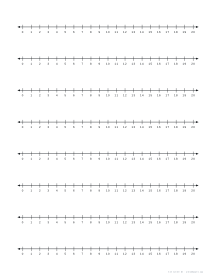
What prints with the starting settings
| Paper | US Letter — 215.9 × 279.4 mm (8.5 × 11 in) |
|---|---|
| Range | 0 to 20 in steps of 1 |
| Lines per page | 8 |
| Margins | 1/2″ |
| Line weight | 0.18 mm (bold 0.35 mm) |
| Print setting | Scale 100% / Actual size |
Why number lines work
A number line makes numbers into distances. Children who see that 7 is three steps beyond 4 are building the same idea they will later use for subtraction, negative numbers, fractions and decimals. Teachers use number lines for counting on and back, skip counting, rounding to the nearest ten, placing fractions, and comparing negative temperatures. Older students use them to show inequalities and solution sets.
A printed sheet of number lines saves drawing them by hand and keeps the spacing even, which matters: if the gaps are uneven, the line stops being a measure.
Choosing range, step and ticks
Range. 0 to 10 or 0 to 20 for early counting; −10 to 10 for introducing negative numbers; 0 to 100 in tens for place value and rounding; 0 to 1 with tenths for decimals.
Step. The labelled step sets how often a number is printed. Steps of 2, 5 and 10 support skip counting and multiplication facts.
Minor ticks. Unlabelled ticks between numbers let students place fractions and decimals. Three minor ticks between whole numbers marks quarters, the most common fraction work at primary level.
Blank labels. Printing only the end points turns the sheet into an exercise: students write in the missing numbers or mark a given value.
Classroom ideas
- Number line hops: write a sum such as 6 + 5 and draw the jumps above the line.
- Rounding: mark a number such as 47 on a 0 to 100 line in tens and decide which ten it is nearer.
- Temperature: use −20 to 20 to compare winter temperatures.
- Fractions: on a line from 0 to 2 with quarters, place ½, ¾, 1¼ and 1½.
Printing tips
Print at 100% / Actual size. For whole-class use, print a single long line per page in landscape orientation and display it on the board; for desks, eight lines per page fits most worksheets.
Popular number line sheets
Frequently asked questions
How do I make a number line with negative numbers?
Set Start at to a negative value, for example −10, and End at to 10. The line is labelled from left to right in your chosen step, with zero in the middle.
Can I add ticks for fractions?
Yes. Minor ticks between labels adds unlabelled marks: 1 gives halves, 3 gives quarters, 4 gives fifths and 9 gives tenths. Combine a step of 1 with 9 minor ticks for a decimal number line.
What are blank number lines for?
With Leave labels blank on, only the first and last numbers are printed. Students fill in the missing values, which practises counting on, skip counting and placing numbers between two known end points.
Can I count in fives, tens or hundreds?
Yes. Set the Labelled step to 5, 10 or 100 and the range to match, for example 0 to 100 in tens or 0 to 1,000 in hundreds.
How many number lines fit on a page?
From 1 to 14. Eight is the default and leaves room to write under each line; fewer, longer lines are easier for young children.
Do the lines have arrows?
Yes, both ends have arrowheads to show that the line continues, which is the usual convention in school maths.
Last updated · About us