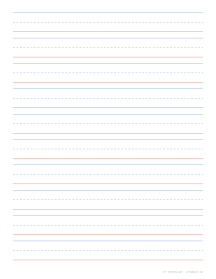
What prints with the starting settings
| Paper | US Letter — 215.9 × 279.4 mm (8.5 × 11 in) |
|---|---|
| Writing height (top to baseline) | 19.05 mm = 3/4″ |
| Writing sets on this page | 10 |
| Midline (x-height) | 3/8″ |
| Margins | 1/2″ |
| Line weight | 0.25 mm (bold 0.35 mm) |
| Print setting | Scale 100% / Actual size |
Standard writing height (top to baseline)
| Writing height (top to baseline) | Millimetres | Inches | Writing sets on Letter | Writing sets on A4 |
|---|---|---|---|---|
| 1/2″ | 12.7 mm | 0.5″ | 13 | 14 |
| 5/8″ | 15.88 mm | 0.625″ | 11 | 12 |
| 3/4″ | 19.05 mm | 0.75″ | 10 | 11 |
| 1″ | 25.4 mm | 1″ | 8 | 8 |
| 1 1/4″ | 31.75 mm | 1.25″ | 6 | 7 |
| 10 mm | 10 mm | 0.394″ | 15 | 17 |
| 15 mm | 15 mm | 0.591″ | 12 | 13 |
| 20 mm | 20 mm | 0.787″ | 9 | 10 |
What handwriting paper is
Handwriting paper, also called primary ruled paper or three-line paper, groups lines into writing sets. Each set has a solid top line, a dashed midline and a solid baseline, and the sets are separated by a small gap so lines of writing don’t run into each other. Unlike ordinary lined paper, which only gives a baseline, these guides show where every part of a letter belongs: ascenders up to the top, lowercase bodies up to the midline, and everything sitting on the baseline.
Preschool and kindergarten teachers use it from the first lessons on letter formation. Occupational therapists rely on it for children who need extra visual structure. Parents print it for homework and holiday practice, and adults use it to retrain messy handwriting or to learn cursive, italic and pointed-pen scripts.
Choosing the writing height
The writing height is measured from the top line down to the baseline. As children’s fine motor control improves, the sets get smaller:
- 1 inch or larger — early learners forming letters for the first time.
- 3/4 inch (19 mm) — the generator’s default and a comfortable middle ground for kindergarten and first grade.
- 5/8 inch (16 mm) — a common step for first and second grade.
- 1/2 inch (12.7 mm) — second and third grade, and the start of cursive.
- 10–15 mm — metric equivalents used in many schools outside the US.
Every school and handwriting program has its own progression, so treat these as starting points. Our ruling-by-grade guide explains how most US classrooms move from primary sets to wide ruled paper. For specific stages there are ready-made pages for first grade and third grade.
Features that help learners
Shade the middle zone. Turning on the shaded band fills the space between the midline and baseline with a soft tint. Children see at a glance that lowercase letters live inside the band, which is often easier to understand than a dashed line alone.
Add a descender line when words and sentences start. Letters with tails then have a clear target, so a g stops looking like a 9.
Increase the gap between sets for children who are still writing large or who press hard, so their letters don’t collide with the line above. A gap of 1/4 inch is the default; 3/8 inch gives more breathing room.
Use slant guides for cursive. A 75° slant suits most school cursive styles, while 55° matches traditional Copperplate. Our cursive and Copperplate pages are preset for each.
Setting it up in the generator
Choose Handwriting paper as the paper type, then pick a writing height preset or enter your own value in inches or millimeters. Set the gap between sets, decide whether you want the descender line, shading or slant guides, and check the preview with True size switched on to see the lines exactly as they will print.
Under Advanced options you can change the line colors: the default blue lines with a red baseline echo classic school paper, but plain gray works better if you plan to photocopy worksheets. Add header fields for Name and Date, type a title like a weekly spelling list, and set Pages in the PDF to build a practice booklet. Copy the link to share the exact setup with other teachers or with parents.
Printing tips
Print at Actual size so the writing height stays true; a 3/4 inch set printed with Fit to page comes out noticeably smaller and may not match the worksheets a child uses at school. For classroom stacks, print one page and measure from top line to baseline before running off thirty copies.
Pencil works on any copy paper, but if children use markers or crayons, a slightly heavier 24 lb (90 g/m²) sheet holds up better. By default the baseline prints in red and the other lines in blue, which helps children who confuse the lines when they are all the same shade. If you switch to a single gray for photocopying, keep the midline dashed so it still stands apart.
Popular handwriting paper sheets
- First grade writing paper (3/4 inch lines)
- Kindergarten writing paper (1 inch lines)
- Cursive handwriting paper with slant lines
- Primary story paper
- Third grade handwriting paper (1/2 inch lines)
- Brush lettering practice sheets (28 mm lines)
- Tian zi ge (田字格) paper
- Copperplate calligraphy guide sheets (55° slant)
- Hindi writing practice paper
- Mi zi ge (米字格) paper
- Preschool writing paper (1 1/4 inch lines)
- Second grade writing paper (5/8 inch lines)
Frequently asked questions
What size handwriting lines does a kindergartner need?
Many kindergarten classrooms start with lines about 1 inch (25 mm) from top to baseline, with a dashed midline at half height. That leaves room for big, still-developing letter shapes. A Letter page fits 8 writing sets at that size. See the kindergarten handwriting paper page for a ready-made setup.
What is the dashed middle line for?
It marks the x-height, the height of lowercase letters such as a, c, e and o. Tall letters like b, d and h reach the top line, and the dashed line shows children where the round part of the letter should stop. On the default 3/4 inch sets, the midline sits 3/8 inch above the baseline.
How many writing lines fit on a page?
At the default 3/4 inch writing height with a 1/4 inch gap between sets, a US Letter page holds 10 sets and an A4 page holds 11. Smaller 1/2 inch sets give 13 on Letter. The spec table above updates as you change the height or gap.
What does the descender line do?
It adds a fourth line below the baseline to show how far the tails of g, j, p, q and y should drop. It is helpful once children start writing full words and sentences, and for cursive practice where loops pass below the baseline.
Can I add slanted guide lines for cursive or calligraphy?
Yes. Choose a slant under the paper settings, from 52° for Spencerian and 55° for Copperplate to 75° for school cursive and 85° for italic. The angle is measured from the baseline, and light diagonal lines are drawn through each set.
Can I put a student's name at the top?
Open Advanced options and add the Name and Date header fields, or type a title such as "Letter practice: Bb". The fields print on every page, which is handy when you make a multi-page practice booklet.
Last updated · About us