Knitting graph paper for every yarn weight
Each setup loads a typical stockinette gauge for one yarn weight, from fine sock yarn to super bulky. Swatch your own yarn and type in your stitches and rows per 10 cm for an exact match.
Fingering weight (socks and Fair Isle)
28 stitches × 36 rows per 10 cm, printed at ×2 so each 3.57 × 2.78 mm stitch becomes a 7.14 × 5.56 mm cell that is easy to color.
Use this setup PDF: US Letter · A4
Sport weight (baby knits and light yokes)
24 stitches × 32 rows per 10 cm at true size. Cells are 4.17 × 3.13 mm, a 4 to 3 shape.
DK (baby garments, mittens, yokes)
22 stitches × 30 rows per 10 cm at true size. Cells are 4.55 × 3.33 mm, 1.36 times wider than tall.
Use this setup PDF: US Letter · A4
Worsted weight (sweaters, hats, intarsia)
18 stitches × 24 rows per 10 cm at true size. Cells are 5.56 × 4.17 mm, 1.33 times wider than tall.
Use this setup PDF: US Letter · A4
Bulky / chunky
14 stitches × 20 rows per 10 cm at true size. Wide 7.14 × 5 mm cells for bold hats, cowls and blankets.
Super bulky / super chunky
10 stitches × 14 rows per 10 cm at true size. Each cell is 10 × 7.14 mm, so a 20-stitch motif is 20 cm wide.
What prints with the starting settings
| Paper | US Letter — 215.9 × 279.4 mm (8.5 × 11 in) |
|---|---|
| Gauge | 20 sts × 28 rows per 10 cm (4″) |
| Cell (w × h) | 5 × 3.571 mm |
| Cell aspect (w:h) | 1.4 : 1 |
| Margins | 1/2″ |
| Line weight | 0.15 mm (bold 0.35 mm) |
| Print setting | Scale 100% / Actual size |
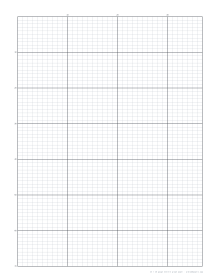
What knitter’s graph paper is for
Knitter’s graph paper is a charting grid with rectangular cells. The width of each cell is one stitch and the height is one row, both calculated from your gauge. Draw a motif on it and the proportions on paper match the proportions in the fabric, which ordinary square graph paper cannot do. A circle drawn on square paper knits up as a squat oval; on bulky yarn, a motif charted on square paper comes out about 30% too short.
Colorwork knitters chart stranded and Fair Isle-style patterns, intarsia pictures and mosaic designs. Designers sketch yoke patterns, cables and lace layouts and work out repeats before swatching. Gift knitters chart names, initials and dates for blankets and stockings. Crocheters use the same grids for tapestry crochet, filet and corner-to-corner blankets. Even if you never draw a motif, a gauge-true grid is handy for planning shaping: a few cells of decrease drawn on paper show exactly how a neckline or sleeve cap will curve.
Gauge by yarn weight
Every yarn weight has a typical stockinette gauge, and each one has a setup above. The cell sizes are at true size; the last column is the grid on a Letter page with half-inch margins in each setup.
| Yarn weight | Stitches × rows per 4″ / 10 cm | Cell at true size (w × h) | Cell shape | Setup grid per Letter page |
|---|---|---|---|---|
| Fingering | about 28 × 36 | 3.57 × 2.78 mm | 1.29 : 1 wide | 26 × 45 (printed ×2) |
| Sport | about 24 × 32 | 4.17 × 3.13 mm | 1.33 : 1 wide | 44 × 80 |
| DK | about 22 × 30 | 4.55 × 3.33 mm | 1.36 : 1 wide | 41 × 75 |
| Generator default | 20 × 28 | 5 × 3.57 mm | 1.4 : 1 wide | 37 × 70 |
| Worsted | about 18 × 24 | 5.56 × 4.17 mm | 1.33 : 1 wide | 33 × 60 |
| Bulky | about 14 × 20 | 7.14 × 5 mm | 1.43 : 1 wide | 26 × 50 |
| Super bulky | about 10 × 14 | 10 × 7.14 mm | 1.4 : 1 wide | 18 × 35 |
These are starting points, not rules. The generator accepts any gauge from 8 to 44 stitches and 8 to 60 rows per 10 cm, so type in your own swatch and the cells, spec table and numbering update together.
Fingering weight: socks, Fair Isle and shawls
Fingering is the sock-and-shawl yarn: thin, light, and knit on small needles. It is the standard for Fair Isle and stranded colorwork, patterned socks, lightweight yokes and shawls with charted motifs. Its stitches are closer to square than heavier yarns, but a round motif charted on square paper still comes out noticeably squashed (wider than it is tall), so peeries, stars and flowers need the 1.29 to 1 cells.
Because true-size cells are fiddly to color, the setup prints at ×2. Traditional Fair Isle bands often repeat over 8 stitches, so try a bold line every 8 (or 6, 12, or whatever matches your repeat). Sock patterns are usually knitted firmer than garments, at around 28 to 36 stitches per 10 cm (7 to 9 per inch), and needle sizes vary widely, so swatch the way you will knit: in the round for socks, flat for a shawl. Chart the leg and foot separately, since the instep often carries the pattern while the sole stays plain, and note the heel position on the leg chart so a motif ends at a natural break.
Lace is usually charted with symbols on square grids for readability; use the proportional grid when the shape of a lace motif matters, such as a leaf or heart in the body of a shawl.
Sport weight: baby knits and light yokes
Sport weight (Craft Yarn Council weight 2) sits between fingering and DK, typically knitted at 23 to 26 stitches per 4 inches on 3.25 to 3.75 mm needles. It is a popular choice for baby clothes, light sweaters and colorwork yokes, with room for small snowflakes, lettering and peeries. The 24 × 32 cells have a neat 4 to 3 shape; enlarge them ×1.5 for easier charting and they keep that shape. To draw a symmetrical motif, chart half of it and mirror it from a bold center line.
DK: baby garments, mittens and stranded yokes
DK (double knitting) sits between sport and worsted. It is a favorite for baby garments, children’s sweaters, mittens and gloves, and stranded yokes, where you want fabric that is warm but not bulky and motifs that look refined. A snowflake drawn on DK cells keeps its six points even, and a name on a baby blanket does not come out tall and narrow. At true size you can check whether a motif fits across a mitten back or a child’s chest before you cast on.
For baby items, a small all-over motif such as tiny hearts or dots spaced every six stitches keeps floats short enough for little fingers. Chart one unit with its spacing, repeat it across the sheet, and try offsetting every other row of motifs by half a repeat for a diagonal layout. Sport and light worsted yarns often knit close to DK; start from this setup and type in your swatch numbers.
Worsted weight: sweaters, hats and intarsia
Worsted is the workhorse yarn for sweaters, hats, mittens and blankets, and often the first yarn knitters use for colorwork. It suits intarsia pictures with large areas of color, stranded bands on hats and yokes, lettering and monograms, which distort badly on square paper, and duplicate-stitch details added after knitting. At true size the chart is the real size of the knitting, so you can hold it against a hat or sweater front to check placement; a bold line every 5 makes counting quicker for small repeats and intarsia blocks.
When charting text for a hat brim or blanket, draw the letters, then check the chart in a mirror if you are knitting from the wrong side, and leave at least two plain stitches between letters, as worsted floats behind longer gaps can catch on fingers.
Bulky and super bulky: big stitches, bold motifs
Bulky yarn (weight 5, also called chunky) typically knits at 12 to 15 stitches per 4 inches on 5.5 to 8 mm needles; the setup uses 14 × 20. Super bulky (weight 6, super chunky) usually knits at 7 to 11 stitches per 4 inches on 8 to 12.75 mm needles; the setup uses 10 × 14, so each stitch is about a centimeter wide. For the thickest yarns, try 12 × 16 or 8 × 12.
Colorwork at these gauges is quick and bold, but proportion mistakes are very visible, so stitch-shaped cells matter more than ever. Keep motifs simple, use the bold lines to center a motif on the front of a hat or blanket, and carry colors over no more than about three stitches in super bulky yarn, or switch to intarsia. Adding a motif after knitting? The duplicate stitch guide on CraftPatterns shows how.
Choosing your gauge
The generator asks for stitches and rows per 10 cm. Most patterns and ball bands give gauge over 4 inches, which is 10.16 cm, close enough that you can enter the same numbers.
For the most faithful chart, knit a swatch in the stitch pattern you will use, block it the way you will block the garment, and count stitches and rows over 10 cm. Stranded colorwork, garter stitch and ribbing all have different row-to-stitch ratios from plain stockinette, and needle size, fiber and personal tension all change gauge: wool and acrylic of the same weight can knit differently on the same needles. If your swatch is 17 stitches and 23 rows, enter 17 and 23; the closer the chart matches your gauge, the more accurately motifs keep their shape.
True size or enlarged
At true size each cell is one stitch, which is what you want for checking fit and placement, or for laying a swatch on the page to confirm your gauge. For drawing, enlarged cells are easier:
- ×1.5 keeps the shape but makes cells bigger, for example 6.82 × 5 mm at DK gauge, and still fits a worsted hat chart on one page.
- ×2 suits colored markers, complex charts with many colors, and knitters who need high-contrast, easy-to-read charts while working: 11.1 × 8.3 mm at worsted gauge.
A good routine is to design on an enlarged grid, then print a true-size copy to check the finished size.
Charting tips
- Mark the center stitch and the pattern repeat first. For circular yokes and hats, the stitch count must divide evenly by the repeat width; for yokes, chart one repeat and note the decrease rounds between motifs.
- Use a pencil for the outline, then fill cells with colored pencils or symbols. A key in the margin keeps colors straight.
- For stranded knitting, watch for long floats: more than five to seven stitches of one color in a row usually needs catching on the back, and fewer in thick yarn. The grid makes long runs easy to spot.
- Remember that charts are read from the bottom right corner for right-side rows, so draw letters so they read correctly from that orientation.
Setting it up in the generator
Choose Knitter’s graph paper as the paper type and your paper size. Enter stitches and rows per 10 cm, then choose true size or an enlarged cell (×1.5 or ×2). Set the bold line interval (10 by default) and turn edge numbering on or off. The spec table confirms the cell size in millimeters and the aspect ratio. Use landscape orientation for wide charts such as yokes and borders.
In Advanced options, a lighter minor line color makes colored-in cells stand out. Add a title with the yarn and needle size so you remember the gauge later, and set more pages for large blanket or sweater charts. For finished patterns to knit straight away, there are charts on our sister site CraftPatterns. Square stitches, such as cross-stitch, are charted on our cross-stitch graph paper instead; fine colorwork has a lot in common with fine 18-count cross-stitch.
Printing tips
Print at Actual size so true-size cells really match your stitches; Fit to page shrinks the grid by a few percent, which adds up across a whole sweater front. Check by measuring ten cells across with a ruler:
| Setup | Default | Fingering (×2) | Sport | DK | Worsted | Bulky | Super bulky |
|---|---|---|---|---|---|---|---|
| Ten cells across | 50 mm | 71.4 mm | 41.7 mm | 45.5 mm | 55.6 mm | 71.4 mm | 100 mm |
A matte, bright white paper takes colored pencil best, and a clear sheet protector lets you mark your current row with a removable highlighter tape.
Frequently asked questions
Why can't I chart knitting on ordinary graph paper?
Because knitted stitches aren't square. In stockinette, a stitch is usually wider than it is tall, so there are more rows than stitches in every 4 inches. A motif charted on square graph paper comes out squashed when knitted: circles turn into wide ovals and letters look short and fat. Knitter's graph paper uses rectangular cells in the same ratio as your gauge, which removes that distortion.
What gauge numbers do I enter?
Enter stitches per 10 cm (4 inches) and rows per 10 cm from your swatch or the yarn label. The default of 20 stitches and 28 rows gives cells 5 mm wide and about 3.57 mm tall. The spec table shows the cell size and the width-to-height ratio for whatever you enter.
What are typical gauges for common yarn weights?
Roughly, in stockinette per 4 inches or 10 cm: fingering about 28 stitches × 36 rows, sport 24 × 32, DK 22 × 30, worsted 18 × 24, bulky 14 × 20 and super bulky 10 × 14. Each has a ready-made setup: fingering, sport, DK, worsted, bulky and super bulky. Your own tension and needle size can change gauge a lot, so measure a swatch when accuracy matters.
Is the gauge per 4 inches or per 10 cm?
Yarn labels quote either, and the two are treated as interchangeable because 4 inches is 10.16 cm. The generator uses 10 cm. The 1.6 mm difference over a 4-inch swatch is far smaller than normal variation between knitters.
Is the paper true to size?
At True size (1:1) each cell matches one stitch of your gauge, so a 40-stitch-wide motif on paper is the same width it will be in your knitting. That lets you lay the chart against a sweater pattern schematic, the actual garment or your swatch. The ×1.5 and ×2 options enlarge the cells for easier charting while keeping the same proportions.
Why does the fingering weight setup print at ×2?
True-size fingering cells are only 3.57 × 2.78 mm, so charting and coloring them is tiring. The ×2 setting doubles them to 7.14 × 5.56 mm with the same proportions. Switch the cell size to true size when you want the chart to match the finished fabric, for example to see how wide a band will be on a sock leg.
How do I plan a yoke or hat repeat?
Count the stitches around, then choose a motif width that divides evenly into that number: on a 110-stitch hat, a motif of 10 or 11 stitches fits exactly. Mark one repeat between bold lines, chart the motif once, and note in the margin how many times it repeats around. Many sock and Fair Isle motifs repeat over 8 stitches, so set Bold line every to 8 for a 64- or 72-stitch sock.
How do I read a knitting chart?
Each cell is one stitch, and charts are read from the bottom up. For flat knitting, read right-side rows from right to left and wrong-side rows from left to right. In the round, read every row from right to left. With numbering on, every bold line is numbered so you can count stitches across and rows up; you can label the edges in pencil to suit flat or circular knitting.
What designs suit bulky and super bulky yarn?
Large, simple shapes: big stars, hearts, chunky letters, wide stripes and Fair Isle bands with short color runs. Fine detail is lost at these gauges, and curves become steps. A 20 × 20 stitch motif covers about 14 × 10 cm in bulky yarn and 20 × 14 cm in super bulky.
Can I use it for crochet?
Yes, for any technique where stitches form a grid, including tapestry crochet, filet crochet, C2C and graphghans. Crochet gauges differ from knitting, so measure your crochet stitches and rows over 10 cm and enter them just as you would for knitting.
Last updated · About us