Variations
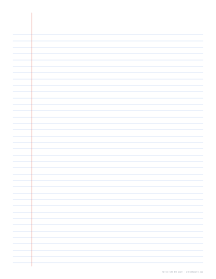
What prints with the starting settings
| Paper | US Letter — 215.9 × 279.4 mm (8.5 × 11 in) |
|---|---|
| Line spacing | 6.35 mm = 1/4″ |
| Ruling | Narrow ruled |
| Writing lines on this page | 36 |
| Margins | 1/2″ |
| Line weight | 0.18 mm (bold 0.35 mm) |
| Print setting | Scale 100% / Actual size |
Small writing, full pages
Narrow ruling is for people whose handwriting has become small and consistent and who would rather turn fewer pages. At four lines to the inch, a Letter sheet holds 36 lines, so notes that fill nine college ruled pages fit on about eight.
It suits a few distinct uses. Bookkeeping uses it for working notes where figures and short phrases need to stay aligned. Lab notes and calculations benefit because the quarter-inch pitch matches quarter-inch graph paper. Writers and diarists with fine-nibbed pens often like the dense, typeset look of a full narrow ruled page. Some high school and university students switch to it for lecture notes once they find a whole lecture fits on fewer pages.
Making a dense page comfortable
Close lines can feel claustrophobic, so a few settings help:
- Pale grey rules soften the page so your writing, not the lines, dominates.
- Fine pens (0.38–0.5 mm) keep loops from touching the line above.
- Skip a line between paragraphs or topics; with 36 lines available you can afford the space.
If you find yourself squeezing letters, step back up to college ruled, which most people find more relaxed for long sessions.
A matching project binder
Because narrow ruling shares its quarter-inch pitch with other inch-based sheets, it works well in a mixed binder. A project notebook might alternate narrow ruled pages for running notes with 1/4 inch dot grid for sketches, so the row height stays the same whichever page you are on and your handwriting does not have to adjust.
Legal-length drafts
The Legal variant stretches the sheet to 14 inches and gives 48 lines, which is useful for long drafts, outlines and minutes. If you want the classic yellow look with a double rule at the top, see the legal pad template, which uses the wider legal ruling instead.
As with every ruled sheet, print at Actual size. Measure from one line to the fourth line below it: the distance should be exactly one inch.
More lined paper sheets
- College ruled paper (Letter & A4)
- Wide ruled paper (Letter & A4)
- Notebook paper (college ruled, with holes)
- A4 lined paper (8 mm feint with margin)
- Writing paper (wide lines for letters and stories)
- Genkō yōshi (Japanese manuscript paper)
- Legal pad paper (yellow, Legal & Letter)
- Seyès paper (French ruled)
- A5 lined paper for journals and planners
- Arabic lined paper (right-hand margin)
- Wongoji (Korean manuscript paper)
- Pitman ruled paper (1/2 inch lines)
Frequently asked questions
What is narrow ruled line spacing?
1/4 inch, or 6.35 mm, between lines. That is the smallest of the three common US rulings: narrow, college (9/32 inch) and wide (11/32 inch).
How many lines are on a narrow ruled page?
On Letter with half-inch margins there are 36 writing lines, four more than college ruled. A4 holds 40 and Legal holds 48.
Who should use narrow ruled paper?
Writers with small, controlled handwriting, such as people keeping dense working notes, lab notes or diaries. It is rarely a good choice for young children, whose letters need more height.
Does narrow ruling line up with 1/4 inch graph paper?
They share the same 1/4 inch pitch, so your handwriting fits the same row height on a narrow ruled page and on 1/4 inch graph paper. The rows will not line up exactly across two sheets, because the lined page leaves a header space at the top.
How do I get even more lines?
Use the variant that removes the header gap and margin line, or choose Legal size. You can also type a smaller custom spacing, such as 6 mm, though below that most handwriting becomes hard to read.
Last updated · About us