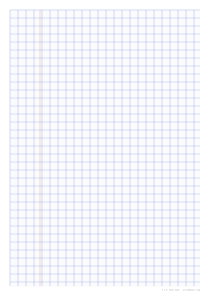
A grid and handwriting lines in one
Seyès paper is named after Jean-Alexandre Seyès (1855–1937), a Paris-born bookseller and stationer who is credited with registering the ruling in 1892, although some accounts say he took the idea from two teachers in Marseille. It is still the standard writing paper in French primary schools, where it is called grands carreaux (large squares).
The page has two systems on top of each other:
- Vertical lines every 8 mm, forming tall columns.
- Bold horizontal lines every 8 mm, which with the vertical lines make 8 mm squares.
- Three fine horizontal lines between each pair of bold lines, splitting each square into four bands 2 mm high.
A margin line runs down the left side for corrections, dates and numbers.
- Seyès, 8 mmstandard: 2 mm bands
- Seyès, 10 mmenlarged: 2.5 mm bands
- Seyès, 12 mmenlarged: 3 mm bands
- Petits carreauxplain 5 mm grid
How the lines are used
French handwriting teaching uses the fine lines to set the height of every letter. Pupils write on a bold line, and letter heights are counted in the 2 mm bands (interlignes). The exact heights vary a little between teaching methods, but the usual scheme is:
| Letters | Height | On 8 mm paper |
|---|---|---|
| Small letters: a, c, e, m, n, o, u | One band | 2 mm |
| Short stems: t, d | About two bands | about 4 mm |
| Tall loops: b, h, k, l | Three bands | 6 mm |
| Descenders: g, j, p, q, y | Below the writing line | 2–6 mm |
Young children often start with taller letters, two bands for small letters, and shrink as their control improves, which is what the enlarged 2.5 mm and 3 mm papers are for. The vertical lines help with letter spacing, keeping the slant steady and lining up columns of numbers.
Sizes and variations
| Ruling | Square | Band | Typical use |
|---|---|---|---|
| Seyès (grands carreaux) | 8 mm | 2 mm | Primary and secondary handwriting |
| Enlarged Seyès | 10 mm | 2.5 mm | Early learners, low vision |
| Enlarged Seyès | 12 mm | 3 mm | The youngest writers |
| Petits carreaux | 5 mm plain grid | none | Maths, secondary school |
In the Seyès generator you can change the square size, turn the margin line on or off and move it. Print on A4 for French school sizes, or on Letter for a US binder. Here is how much writing each fits, straight from the generator:
| Paper | 8 mm squares | 10 mm squares | 12 mm squares |
|---|---|---|---|
| A4 | 34 | 27 | 23 |
| US Letter | 31 | 25 | 21 |
Moving a child onto Seyès paper
- Start large. Begin on 3 mm or 2.5 mm bands, with small letters two bands high, until letter shapes are secure.
- Name the lines. Point out the bold writing line and count bands aloud: “one band for a, three for l”.
- Practise one letter family at a time: round letters (a, c, d, o), then tall loops (b, h, k, l), then descenders.
- Step down to 8 mm once letters sit on the line and stay a consistent height without reminders.
- Use the vertical lines for spacing: one column per small letter is a good starting rhythm.
Printing tips
Because the fine lines are only 2 mm apart, accuracy matters: if a printer shrinks the page by 3%, the bands become 1.94 mm and children’s letters drift. Print at 100% / Actual size and check by measuring ten squares, which should be exactly 80 mm. If they are not, calibrate your printer once. Light blue or violet lines, the traditional French colours, keep the grid visible without overpowering the writing; our default uses pale blue fine lines and a stronger blue for the bold lines.
Who else uses it
Beyond France, Seyès paper is used in Belgium, Switzerland and French-speaking Africa, and it has fans among calligraphers and teachers of cursive in English, because the fine lines teach consistent letter heights without the clutter of a full handwriting worksheet. For English-language schools, our guide to which ruling for which grade covers primary, wide and college ruled paper.