Variations
What prints with the starting settings
| Paper | A4 — 210 × 297 mm (8.27 × 11.69 in) |
|---|---|
| Boxes per page | 400 (20 lines × 20) |
| Layout | Horizontal rows (wongoji) |
| Margins | 10 mm |
| Line weight | 0.2 mm (bold 0.35 mm) |
| Print setting | Scale 100% / Actual size |
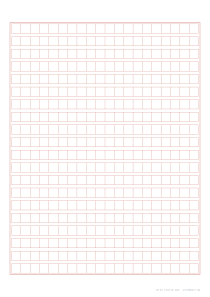
Writing Korean in boxes
Wongoji (원고지) gives every syllable its own square, so compositions stay neat and their length can be counted at a glance. Korean school essays have traditionally been written on it, and learners of Korean use it to master spacing rules, which matter a great deal in Korean writing: spaces between words take a box, and punctuation has its own placement conventions.
Practising for exams
Writing on a grid under time pressure is different from typing, and the TOPIK writing section uses answer grids in the same style. Printing a few sheets and practising full answers is a good way to learn how much text fits, where to indent and how to handle numbers and punctuation.
Printing tips
Print at 100% / Actual size on A4. The gutter between rows is set to about a third of a box, room for small corrections.
More lined paper sheets
- College ruled paper (Letter & A4)
- Wide ruled paper (Letter & A4)
- Notebook paper (college ruled, with holes)
- A4 lined paper (8 mm feint with margin)
- Narrow ruled paper (Letter, A4 & Legal)
- Writing paper (wide lines for letters and stories)
- Genkō yōshi (Japanese manuscript paper)
- Legal pad paper (yellow, Legal & Letter)
- Seyès paper (French ruled)
- A5 lined paper for journals and planners
- Arabic lined paper (right-hand margin)
- Pitman ruled paper (1/2 inch lines)
Frequently asked questions
How is wongoji different from genkō yōshi?
Wongoji is usually written horizontally, left to right in rows, while genkō yōshi is written in vertical columns from right to left. Both use one box per character with a gutter between lines.
What goes in each box?
One Hangul syllable block, one punctuation mark, or two Latin letters or digits. A space between words takes an empty box.
Why do learners practise on wongoji?
The writing section of the TOPIK (Test of Proficiency in Korean) uses manuscript-style answer grids, so practising on wongoji builds familiarity with its conventions.
Can I change the number of boxes?
Yes, from 5 to 30 boxes per row and 5 to 30 rows.
How do I start a paragraph?
Leave the first box of the row empty, the usual indentation rule.
Last updated · About us