More graph paper sizes, from 1/10 inch and 2.5 mm to 3/8 inch and B5
Each setup opens the generator with that grid already chosen, so you can change the paper size, margins or bold lines before you download the PDF.
1/10 inch (10 squares per inch)
2.54 mm squares with a bold line every inch, so each small square reads as 0.1. 75 × 100 squares on Letter, for decimal plotting, lab graphs and circuit layouts.
1/5 inch (5 squares per inch)
5.08 mm squares with a bold line every inch, the plain white grid for science and lab graphs. 37 × 50 squares on Letter, 37 × 54 on A4.
3/8 inch (large squares)
9.525 mm squares with no bold lines, 20 × 26 on Letter. Room for a child's handwritten digit in each square, and easier to see for low vision.
2.5 mm (4 squares per cm)
A fine metric grid with a bold line every centimetre, 76 × 110 squares on A4, for precise graphs and scale drawings.
3 mm fine grid
A bold line every 10 squares (3 cm), 63 × 92 squares on A4. Detailed but still easy to see, for technical sketches and charts with many points.
4 mm squared paper
A bold line every 5 squares (2 cm), 47 × 69 squares on A4. The compact grid of European maths exercise books, for small handwriting.
B5 graph paper (5 mm squares)
Plain 5 mm squares on ISO B5 (176 × 250 mm), 31 × 46 per page. Switch to JIS B5 for Japanese notebooks and binders (32 × 47).
What prints with the starting settings
| Paper | US Letter — 215.9 × 279.4 mm (8.5 × 11 in) |
|---|---|
| Square size | 6.35 mm = 1/4″ |
| Squares per inch | 4 |
| Squares per cm | 1.575 |
| Grid on this page | 30 × 40 squares |
| Margins | 1/2″ |
| Line weight | 0.18 mm (bold 0.35 mm) |
| Print setting | Scale 100% / Actual size |
Standard square size
| Square size | Millimetres | Inches | Per inch | Grid on Letter | Grid on A4 |
|---|---|---|---|---|---|
| 1/10″ | 2.54 mm | 0.1″ | 10 | 75 × 100 | 74 × 109 |
| 1/8″ | 3.18 mm | 0.125″ | 8 | 60 × 80 | 59 × 87 |
| 1/5″ | 5.08 mm | 0.2″ | 5 | 37 × 50 | 37 × 54 |
| 1/4″ | 6.35 mm | 0.25″ | 4 | 30 × 40 | 29 × 43 |
| 3/8″ | 9.53 mm | 0.375″ | 2.67 | 20 × 26 | 19 × 29 |
| 1/2″ | 12.7 mm | 0.5″ | 2 | 15 × 20 | 14 × 21 |
| 1″ | 25.4 mm | 1″ | 1 | 7 × 10 | 7 × 10 |
| 1 mm | 1 mm | 0.039″ | 25.4 | 190 × 254 | 190 × 277 |
| 2 mm | 2 mm | 0.079″ | 12.7 | 95 × 127 | 95 × 138 |
| 2.5 mm | 2.5 mm | 0.098″ | 10.16 | 76 × 101 | 76 × 110 |
| 3 mm | 3 mm | 0.118″ | 8.47 | 63 × 84 | 63 × 92 |
| 4 mm | 4 mm | 0.157″ | 6.35 | 47 × 63 | 47 × 69 |
| 5 mm | 5 mm | 0.197″ | 5.08 | 38 × 50 | 38 × 55 |
| 10 mm | 10 mm | 0.394″ | 2.54 | 19 × 25 | 19 × 27 |
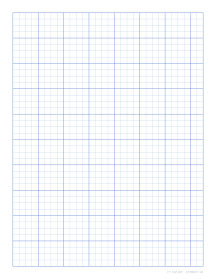
To draw on graph paper on screen, plot points or graph an equation before printing, use the online graph paper.
What graph paper is used for
Graph paper turns any page into a measuring tool. Maths students use it to keep columns of figures aligned, plot functions and draw coordinate geometry; a quarter-inch grid is the standard size in American middle and high schools because a pencil-written digit fits neatly in one square. Scientists and lab students plot readings on decimal grids such as ten or five squares per inch. Engineers and architects sketch floor plans at a scale such as 1/4 inch = 1 foot, so every square is a foot of real space. Designers and game makers rough out pixel art, level maps and UI layouts; crafters chart knitting, cross-stitch and quilt blocks (though our cross-stitch grids and knitter’s graph paper match real fabric counts and gauges more closely).
Graph paper sizes at a glance
Every size below prints exactly to scale. Sizes with their own page link there; the others open in the generator above, already set up. Square counts use the default margins (half an inch on Letter, 10 mm on A4); the spec table above shows the exact count for any paper and margins you choose.
| Square size | Squares per inch or cm | Letter | A4 | Good for |
|---|---|---|---|---|
| 1 mm | 10 per cm | 190 × 254 | 190 × 277 | Technical drawing, pattern drafting |
| 2 mm | 5 per cm | 95 × 127 | 95 × 138 | Precise plotting, lab graphs |
| 2.5 mm | 4 per cm | 76 × 101 | 76 × 110 | Fine charts, scale drawings |
| 1/10 inch (2.54 mm) | 10 per inch | 75 × 100 | 74 × 109 | Decimal plotting, circuit layouts |
| 3 mm | 3.33 per cm | 63 × 84 | 63 × 92 | Detailed sketches, dense charts |
| 1/8 inch (3.175 mm) | 8 per inch | 60 × 80 | 59 × 87 | Floor plans, detailed diagrams |
| 4 mm | 2.5 per cm | 47 × 63 | 47 × 69 | Small handwriting, compact maths notes |
| 5 mm | 2 per cm | 38 × 50 | 38 × 55 | The everyday metric school grid |
| 1/5 inch (5.08 mm) | 5 per inch | 37 × 50 | 37 × 54 | Science and lab graphs |
| 1/4 inch (6.35 mm) | 4 per inch | 30 × 40 | 29 × 43 | US school maths (“quad ruled”) |
| 3/8 inch (9.525 mm) | 2.67 per inch | 20 × 26 | 19 × 29 | Young learners, low vision |
| 1 cm | 1 per cm | 19 × 25 | 19 × 27 | Primary maths, base-ten work |
| 1/2 inch (12.7 mm) | 2 per inch | 15 × 20 | 14 × 21 | Early grades, quilt blocks, big diagrams |
| 1 inch (25.4 mm) | 1 per inch | 7 × 10 | 7 × 10 | Tabletop battle maps, board games |
Some layouts have their own pages too: engineering paper (5 squares per inch on a pale green pad with a header), quilting graph paper, and larger sheets in A3, 11×17 and legal size. For metric grids on A4 specifically, see A4 graph paper.
Choosing a square size
Pick the spacing by what you will write or draw in each square:
- 1 to 3 mm, or 1/10 to 1/8 inch — dense data, detailed plans, small sketches and pixel art. Hard to write in.
- 4–5 mm or 1/5 inch — technical sketches, lab notebooks, compact handwriting. Five squares per inch makes decimal measuring easy.
- 1/4 inch or 6 mm — the all-rounder for algebra, geometry and general notes.
- 3/8 inch or 1 cm — one digit per square for children learning column arithmetic, and larger cells for low vision.
- 1/2 inch to 1 inch — the youngest children, large diagrams, tabletop game maps (1 inch is the standard miniature scale).
A bold line every 4 or 5 squares (every inch, or every centimetre on a 2 mm grid) makes counting much faster; turn it off for a uniform grid.
Inch and metric grids that look alike are not interchangeable. 1/10 inch is 2.54 mm, not 2.5 mm, and 1/5 inch is 5.08 mm, not 5 mm; over a page the difference adds up to a few millimetres. Use the grid that matches the ruler, scale or instructions you are working with.
Decimal inch grids: 1/10 and 1/5 inch
Most US graph paper divides the inch into quarters or eighths, which mirrors a tape measure. Decimal grids follow the other American system, decimal inches, used on engineer’s scales, in machining, in surveying (where field books record tenths of a foot) and in electronics. Both keep a bold line at every inch, so each bold square is one whole inch.
1/10 inch graph paper (10 squares per inch)
Tenth-inch squares (2.54 mm) turn every bold inch into 1.0 and every small square into 0.1, so a value like 3.7 is three bold lines plus seven squares, with no fractions to convert. Through-hole electronic parts sit on a 0.1 inch pitch, so one small square equals one hole on a standard perfboard or breadboard, which makes the grid handy for planning a circuit layout component by component.
In classrooms it is useful for teaching decimals: a 10 × 10 block bounded by bold lines is one whole, a row is one tenth and a single square is one hundredth. Students can shade 0.37 of a block and compare it with 0.4 in the block next to it. Money works the same way, with a dollar per block, a dime per row and a cent per square.
For lab graphs, decide what each bold inch represents (1, 10 or 100 units) and plot to the nearest small square. A Letter page holds 75 × 100 squares, so a range of 0–100 fits vertically at single-unit resolution, and a run of 75 readings fits one per column; turn the page to landscape for 100 columns. To start the axes flush with the bottom-left margin, open Advanced options and turn off Centre the grid on the page. If the lines look crowded on your printer, make the minor lines lighter and keep the bold inches dark. If your data spans several powers of ten, a straight-line grid squashes the small values; use log graph paper instead.
1/5 inch graph paper (5 squares per inch)
Five squares to the inch, each 0.2 inch (5.08 mm), with a heavier line every inch: the decimal-friendly grid of science labs and engineering notebooks. Natural scales are 1, 2, 5 or 10 units per square, so each bold line marks 5, 10, 25 or 50 units. Plotting temperatures from 0 to 100 °C at 2 °C per square uses exactly ten bold inches, the full 50-square height of a Letter page. It also suits drawing to a decimal scale such as 1 inch = 10 feet.
This is the same ruling as engineering paper, but on plain white without the pad styling, which is better for graphs you photocopy or hand in with a lab report. Lab graphs are often submitted with readings taken off the grid, so print at actual size and check that one bold square measures exactly an inch. For experiments over time, turn the page to landscape to give the horizontal axis more room.
Fine metric grids: 2.5 mm, 3 mm and 4 mm
Between the precise 2 mm grid and everyday 5 mm squares there are three useful in-between sizes. Fine grids look sharpest from a laser printer.
2.5 mm graph paper (4 squares per cm)
Four squares make exactly one centimetre, and the bold line every centimetre makes the page read like a metric ruler in both directions. That makes it easy to plot values to a quarter unit and to read measurements without counting dozens of tiny squares. Scale plans work out neatly: at 1:40 each square is 10 cm, at 1:100 it is 25 cm. It also suits electronics and model-making layouts drawn close to real size, and embroidery or pixel designs that need more detail. Set the bold line to every 8 squares for a 2 cm major grid.
3 mm graph paper
At 3 mm, squares are small enough for detail but large enough to see easily without a magnifier, a good compromise when 5 mm feels clumsy and 2 mm looks like a grey blur. The bold line every ten squares makes 3 cm blocks; choose every five squares (15 mm) for more frequent guides. Use it for technical sketches and floor plans (at 1:100 each square is 30 cm), charts with many data points, and cross-stitch, knitting or bead sketches before you transfer them to a true-size chart.
4 mm graph paper
Four millimetres is the pitch of squared exercise books in parts of Europe, notably Spain’s 4 × 4 mm cuadrícula. Each square is a fifth narrower and shorter than 5 mm, so an A4 page holds about 55% more squares (47 × 69 against 38 × 55). It suits maths notes with one digit per square and long calculations on one page, compact lists, detailed flowcharts and pixel sketches. The bold line every five squares is exactly 2 cm; turn it off for a plain European squared look. If you would rather the grid almost disappeared, 4 mm dot grid gives the same spacing with only a dot at each corner.
3/8 inch graph paper for big handwriting
Standard quad-ruled paper is fine for older students but cramped for a seven-year-old writing one digit per box. Three-eighths of an inch, a little under a centimetre, gives each digit room while still fitting a full sum across the page, which makes it a popular middle step between 1/2 inch squares for the youngest children and the 1/4 inch paper of later grades.
- Column arithmetic: one digit per square keeps ones, tens and hundreds aligned in addition, subtraction and multiplication.
- Arrays and area: colour rectangles of squares to show multiplication facts or count areas. A bold line every 5 squares helps with counting.
- Low vision: larger cells are easier to see and write in; in Advanced options choose a darker grey line and a heavier weight, which also photocopies better.
- Quick floor plans: at one square to one foot, a 12 × 15 foot room is a tidy 12 × 15 squares.
For classwork, add a title and name and date fields, then raise Pages in the PDF to get a class set in one file.
Letter, A4, B5 or something else?
Use the paper that is already in your printer: US Letter in the US, Canada and parts of Latin America, A4 nearly everywhere else. A4 is 6 mm narrower and 18 mm taller than Letter, so the same spacing gives a slightly different number of squares — the table above shows both. For posters and big diagrams choose Tabloid (11 × 17 in) or A3; for planners and journals A5 or Half Letter.
B5 graph paper (ISO and JIS)
B5 is a favourite size for maths and science notebooks: wider than A5 for long equations and diagrams, smaller than A4 to carry around. Plain 5 mm squares are the most common ruling in B5 notebooks in Japan and Europe, with 4 mm used for small handwriting. Printed pages work as refills for B5 binders and discbound notebooks.
| Size | Page (mm) | 5 mm squares with default margins |
|---|---|---|
| A5 | 148 × 210 | 25 × 38 |
| ISO B5 | 176 × 250 | 31 × 46 |
| JIS B5 | 182 × 257 | 32 × 47 |
| A4 | 210 × 297 | 38 × 55 |
Choose ISO B5 for European journals and JIS B5 for Japanese notebooks and binders; the grid is centred on either. The B5 setup has no bold lines by default, for a clean notebook look; set a bold line every 4 squares for 2 cm blocks. No B5 paper? Print at 100% on A4 and trim. For the same page size in other rulings, see B5 lined paper or the 5 mm dot grid.
Tips for printing a grid that measures true
Because every square should be exactly the size stated, scaling matters more than on an ordinary document. Print the PDF rather than a screenshot or image, choose Actual size, and check the result with a ruler: ten quarter-inch squares should measure 2.5 inches (63.5 mm). If it is off by more than half a millimetre, run the printer calibration once.
Quick checks for other sizes:
| Grid | Measure | Should be |
|---|---|---|
| 1/10 inch | 10 squares | 1 inch (25.4 mm) |
| 1/5 inch | 5 squares (one bold square) | 1 inch (25.4 mm) |
| 3/8 inch | 10 squares | 3 3/4 inches (95.25 mm) |
| 2.5 mm | 4 squares | 10 mm |
| 3 mm | 10 squares | 30 mm |
| 4 mm | 5 squares (one bold square) | 20 mm |
| 5 mm (B5) | 10 squares | 50 mm |
Popular graph paper sheets
- 1/4 inch graph paper (Letter & A4)
- 5 mm graph paper (A4, Letter & A3)
- 1/8 inch graph paper (Letter, A4 & Legal)
- 1 cm graph paper (centimeter squares)
- Engineering paper (5 squares per inch)
- 1 inch graph paper (Letter, A4 & 11×17)
- A4 graph paper (5 mm, 1 cm, 2 mm & more)
- 1/2 inch graph paper (large squares)
- 1 mm graph paper (millimetre paper)
- 11×17 graph paper (Tabloid & Ledger)
- 2 mm graph paper (bold every centimeter)
- A3 graph paper for large drawings and plans
- Quilting graph paper
- Legal size graph paper (8.5 × 14 in)
Frequently asked questions
What is the most common graph paper size?
In the US it is 1/4 inch squares (4 squares per inch) on Letter paper, often sold as "quad ruled". Outside North America the usual choice is 5 mm squares on A4. Both are one click away above.
What is the difference between graph paper and grid paper?
None in practice — both mean paper ruled with a square grid. "Graph paper" is more common in the US for maths, "grid paper" in the UK and for crafts. Engineering paper is a graph paper variant with 5 squares per inch and a bold line every inch.
How many squares are on a sheet of 1/4 inch graph paper?
With half-inch margins a US Letter sheet fits 30 × 40 quarter-inch squares; with printer-safe 6 mm margins you get 32 × 41 (the footer line takes the last row). The spec table above updates as you change the margins.
Why use 10 or 5 squares per inch instead of 4?
Tenths and fifths line up with decimal numbers. On 1/10 inch paper a value like 3.7 is three bold lines plus seven small squares; on 1/5 inch paper each square is 0.2 inch. Four squares per inch works in quarters, which suits fractions, tape-measure work and drafting.
Is 1/10 inch the same as 2.5 mm, or 1/5 inch the same as 5 mm?
Close, but not identical. 1/10 inch is 2.54 mm, so over a full page it drifts about 4 mm from a 2.5 mm grid. 1/5 inch is 5.08 mm, which drifts about 1 mm every 12 squares from 5 mm. In the same way 3/8 inch (9.525 mm) is a little smaller than 1 cm, and 3 mm is not quite 1/8 inch (3.175 mm). Pick the grid that matches the ruler you will use.
Which graph paper size is best for young children or low vision?
Who uses 4 mm squared paper?
It is common in maths exercise books in parts of Europe, such as Spain, and among people with small handwriting who find 5 mm squares too roomy. One letter per square is tight but workable for most adults; many write one line every square and a half or two. See 4 mm.
How many squares fit on B5 graph paper?
With 5 mm squares and the default margins, 31 × 46 on ISO B5 (176 × 250 mm) and 32 × 47 on JIS B5 (182 × 257 mm). You can also print the B5 setup at 100% on A4 and trim it to size.
Why do my squares measure slightly smaller than they should?
Your print dialog is probably set to "Fit to page", which shrinks the page by about 3–6%. Choose Scale 100% or Actual size. Our calibration wizard can correct any remaining printer error.
Can I print graph paper with axes for algebra?
Yes — open Advanced options and turn on X/Y axes through the centre. Combine with 1/4 inch squares and a bold line every 5 squares for a classic coordinate plane.
Is the PDF vector or an image?
Vector. Every line is drawn at its exact position, so it stays crisp on any printer and the file is tiny — a 50-page pad is still under 50 KB.
Last updated · About us