Variations
What prints with the starting settings
| Paper | A4 — 210 × 297 mm (8.27 × 11.69 in) |
|---|---|
| Square size | 8 mm = 0.315″ |
| Fine line spacing | 2 mm |
| Writing lines on this page | 34 |
| Margins | 10 mm |
| Line weight | 0.18 mm (bold 0.35 mm) |
| Print setting | Scale 100% / Actual size |
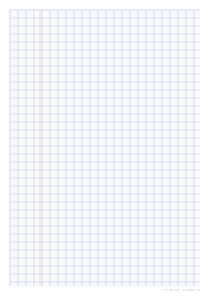
The ruling behind French handwriting
Open almost any French primary school exercise book and you will find Seyès ruling. Its combination of bold lines, fine guide lines and vertical lines gives children a precise frame for the joined-up handwriting taught in France, Belgium and several other French-speaking countries. Each letter has a set height in fine-line units, and the vertical lines help keep slant and spacing even.
Families abroad who follow the French curriculum print Seyès because it is hard to find in shops outside France. Teachers of French as a foreign language use it to show learners how French cursive is formed. Calligraphy and handwriting enthusiasts like it for practising consistent letter heights.
How to write on it
Lowercase letters without ascenders sit in the first 2 mm band above a bold line. Letters with loops, such as l, h and b, rise to the third fine line. Capitals reach three bands too. Descenders such as g, p and q drop below the bold line into the bands underneath. The squares formed by the vertical lines help keep spacing between words regular.
Printing tips
Print at 100% / Actual size so the 8 mm spacing is true; at “fit to page” the ruling shrinks and letters no longer match exercise books. The fine lines are pale blue and the bold lines a little darker, as in printed notebooks.
More lined paper sheets
- College ruled paper (Letter & A4)
- Wide ruled paper (Letter & A4)
- Notebook paper (college ruled, with holes)
- A4 lined paper (8 mm feint with margin)
- Narrow ruled paper (Letter, A4 & Legal)
- Writing paper (wide lines for letters and stories)
- Genkō yōshi (Japanese manuscript paper)
- Legal pad paper (yellow, Legal & Letter)
- A5 lined paper for journals and planners
- Arabic lined paper (right-hand margin)
- Wongoji (Korean manuscript paper)
- Pitman ruled paper (1/2 inch lines)
Frequently asked questions
What is Seyès ruling?
A French ruling named after Jean-Alexandre Seyès, who devised it in the 1890s. Bold horizontal lines 8 mm apart are each divided into four 2 mm bands by three fine lines, and vertical lines every 8 mm form "grands carreaux" (large squares).
How do children use the fine lines?
Each 2 mm band is one unit of letter height. Small letters such as a, o and n fill one band above the bold line; tall letters such as l and b rise three bands; letters with descenders drop below. This gives cursive a consistent proportion.
Can I print Seyès on US Letter?
Yes. The squares stay 8 mm; only the number of lines changes. Choose Letter in the size menu.
Where should the margin be?
French exercise books typically have a red margin a few centimetres from the left edge. The default here is 40 mm, which you can move in the advanced options or turn off.
Is there a smaller version?
"Petits carreaux", simple 5 mm squares, is the other common French ruling; use 5 mm graph paper for that.
Last updated · About us