Variations
What prints with the starting settings
| Paper | A4 — 297 × 210 mm (11.69 × 8.27 in), landscape |
|---|---|
| Boxes per page | 400 (20 lines × 20) |
| Layout | Vertical columns, read right to left (genkō yōshi) |
| Margins | 10 mm |
| Line weight | 0.2 mm (bold 0.35 mm) |
| Print setting | Scale 100% / Actual size |
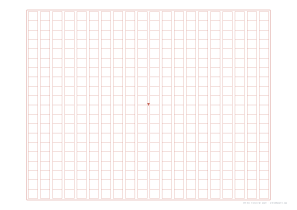
The grid behind Japanese writing
Genkō yōshi is the manuscript paper Japanese students use for compositions, essays and exam answers, and writers have traditionally used for manuscripts. Each square holds one character, and the grid makes it easy to count characters, which is how lengths are set in Japanese assignments.
Learners of Japanese use it to practise correct proportions for kanji and kana, the conventions for punctuation, and the rules of vertical writing: where small characters sit in their square, how long vowel marks rotate, and where to indent a new paragraph (one empty square at the top of the column).
Layout options
The default is the classic 20 columns of 20 boxes with a gutter beside each column and a fold mark in the centre, printed in landscape. A 200-square sheet suits short answers, and a 10 × 10 sheet with bigger boxes suits beginners. For horizontal writing in Korean, see wongoji.
Printing tips
Print at 100% / Actual size in landscape. The boxes and frame are drawn in the reddish-brown ink traditional for manuscript paper, which you can change in the advanced options.
More lined paper sheets
- College ruled paper (Letter & A4)
- Wide ruled paper (Letter & A4)
- Notebook paper (college ruled, with holes)
- A4 lined paper (8 mm feint with margin)
- Narrow ruled paper (Letter, A4 & Legal)
- Writing paper (wide lines for letters and stories)
- Legal pad paper (yellow, Legal & Letter)
- Seyès paper (French ruled)
- A5 lined paper for journals and planners
- Arabic lined paper (right-hand margin)
- Wongoji (Korean manuscript paper)
- Pitman ruled paper (1/2 inch lines)
Frequently asked questions
How do I read genkō yōshi?
Columns are read from top to bottom, starting with the right-hand column and moving left. Each square holds one character, including small kana and most punctuation.
Why is it 20 × 20?
Four hundred characters per sheet is the long-standing standard in Japanese schools and publishing, so essay and composition lengths are often given in sheets of 400 characters.
What is the narrow column beside each line?
A gutter used for furigana (reading aids next to kanji) and for corrections. Its width is adjustable.
What is the mark in the middle?
Traditional genkō yōshi has a centre column where the sheet is folded; the small mark shows that fold line.
Which paper size should I use?
B4 and A4 in landscape are common in Japan. Letter works too; the squares are sized to fit.
Last updated · About us