What prints with the starting settings
| Paper | US Letter — 215.9 × 279.4 mm (8.5 × 11 in) |
|---|---|
| Triangle side | 6.35 mm = 1/4″ |
| Margins | 1/2″ |
| Line weight | 0.18 mm (bold 0.35 mm) |
| Print setting | Scale 100% / Actual size |
Standard triangle side
| Triangle side | Millimetres | Inches | Per inch | Grid on Letter | Grid on A4 |
|---|---|---|---|---|---|
| 5 mm | 5 mm | 0.197″ | 5.08 | 38 × 50 | 38 × 55 |
| 7 mm | 7 mm | 0.276″ | 3.63 | 27 × 36 | 27 × 39 |
| 10 mm | 10 mm | 0.394″ | 2.54 | 19 × 25 | 19 × 27 |
| 15 mm | 15 mm | 0.591″ | 1.69 | 12 × 16 | 12 × 18 |
| 1/4″ | 6.35 mm | 0.25″ | 4 | 30 × 40 | 29 × 43 |
| 1/2″ | 12.7 mm | 0.5″ | 2 | 15 × 20 | 14 × 21 |
| 1″ | 25.4 mm | 1″ | 1 | 7 × 10 | 7 × 10 |
What isometric paper is
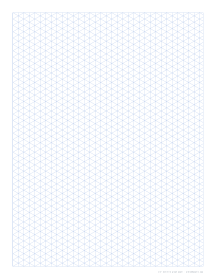
Isometric paper is ruled with three sets of parallel lines: one set at 30° above horizontal, one at 30° below, and usually a set of verticals. Together they divide the page into equilateral triangles. The angles match isometric projection, the technical-drawing view in which the three axes of an object are shown 120° apart and drawn at equal scale. Sketch along the grid and boxes, staircases and machine parts look three-dimensional automatically, with no vanishing points to work out.
Students meet it in middle school geometry when they draw cube structures and explore volume. Engineers and product designers use it for quick exploded views and assembly sketches. Architects and interior designers rough out room layouts in 3D. Game artists plan isometric levels and pixel art, and crafters use the triangle grid for quilt blocks, tessellations and bead patterns. If you want to learn the technique, our isometric drawing basics guide starts from a single cube.
Choosing the triangle size and style
The triangle side is the spacing between points along any grid line. Smaller triangles give more detail, larger ones are easier to count:
- 3–4 mm — detailed technical sketches and isometric pixel art.
- 5 mm or 1/4 inch — the general-purpose size for sketching on Letter or A4. See the 5 mm and 1/4 inch pages.
- 10 mm or 1/2 inch — classroom cube drawings and large diagrams.
- 1 inch — very young students, and printed templates for building or folding.
Choose lines if you need to trace edges a long way across the page or if you are teaching the method. Choose dots when you want the drawing to stand on its own: the points mark every corner, but there are no lines left behind once you ink the shape.
Tips for drawing on isometric paper
- Start every object from its nearest vertical edge, then follow the two 30° lines away from it.
- Only lines parallel to the three axes are true length. Diagonals across a face are foreshortened, so count grid units along the axes instead.
- Circles become ellipses on isometric faces. Box them in a rhombus first, then sketch the ellipse inside.
- Use a light grid color so shading and hatching read clearly over it.
- Shade the three visible faces of an object in three different tones, light on top and darker on the sides, and the 3D effect becomes much stronger.
Setting it up in the generator
Pick Isometric paper as the paper type and choose your paper size. Select a triangle side from the presets in millimeters or inches, or type a custom value. Under the paper settings choose Lines or Dots, and switch vertical lines on or off. Landscape orientation gives a wider sheet for long objects such as bridges, trains or panoramic level maps.
Advanced options lets you set the line color and weight; a pale blue or gray at the default 0.18 mm weight stays visible without competing with pencil. You can also add a title, set a page count for a sketchbook, and export SVG if you want to import the grid into design software as a background layer.
Printing tips
Print the PDF at Actual size so the triangles keep their exact proportions and size. Isometric grids are less forgiving of scaling than square grids because a non-uniform scale also distorts the 30° angles, so if your printer stretches one direction more than the other, run the printer calibration once.
For finished drawings, a light grid printed on 24–28 lb (90–105 g/m²) paper takes markers and fine-liners without bleeding. If you plan to scan your drawing and remove the grid, print the lines in light blue.
Popular isometric graph paper sheets
Frequently asked questions
What is isometric paper used for?
Drawing three-dimensional objects on a flat page. Because the grid lines run at 30° either side of horizontal plus vertical, the three edges of a cube all sit on grid lines and appear equal in length. It is used for technical sketches, product and furniture design, level design, isometric pixel art, origami diagrams and geometry lessons.
What size triangles should I choose?
A 1/4 inch (6.35 mm) or 5 mm triangle side suits most sketching on Letter or A4. Choose 10 mm or 1/2 inch for younger students building cube models, and go down to 3–4 mm for detailed architecture or pixel art. The triangle side is the distance between neighboring points along any grid line.
Should I use isometric lines or isometric dots?
Lines make it easy to follow an edge across the page, which helps beginners. Dots give the same alignment with a much cleaner look, so finished drawings need no erasing and photocopy well. Try isometric dot paper if your lines will be inked over.
Why does my isometric paper have vertical lines?
Vertical lines mark the upright edges of objects, such as the corners of a building. They are on by default, and together with the two 30° sets they complete the triangles. Turn Vertical lines off and only the slanted lines remain, which leaves a grid of 60° diamonds, a quieter background that suits tessellations, quilt blocks and lettering.
Is isometric paper the same as triangle graph paper?
Yes, in practice. Both are grids of equilateral triangles. "Isometric" emphasizes the drawing use, while "triangle grid" is more common in math classes and quilting. Here one set of lines runs vertically, which is the standard orientation for isometric drawing.
How do I check the grid printed at the right size?
Measure along a vertical line across ten triangle sides. On 1/4 inch paper that distance should be 2.5 inches (63.5 mm); on 5 mm paper it should be 50 mm. If it comes out shorter, your printer scaled the page, so reprint at 100% or Actual size.
Last updated · About us