Variations
What prints with the starting settings
| Paper | A4 — 210 × 297 mm (8.27 × 11.69 in) |
|---|---|
| Line spacing | 8 mm = 0.315″ |
| Ruling | Medium ruled |
| Writing lines on this page | 31 |
| Margins | 10 mm |
| Line weight | 0.18 mm (bold 0.35 mm) |
| Print setting | Scale 100% / Actual size |
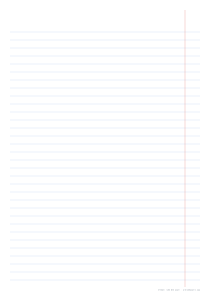
Ruled for right-to-left writing
Most free lined paper puts the margin on the left, which is the wrong side for Arabic. On this paper the red margin line is 25 mm from the right edge, so each line of writing starts in the right place, and the space beside it holds the date, question numbers or a teacher’s marks, as it does in school exercise books in Arabic-speaking countries.
Line spacing and Arabic script
Arabic letters sit on the line and many have dots or marks above or below, plus descending tails in letters like ع, ن and ي. Line spacing needs room for all of them without one line’s marks clashing with the next:
- 8 mm is the everyday choice for students and adults.
- 10 mm is better for beginners, calligraphy practice with a fine pen and writing with full vowel marks (tashkeel).
Uses
Homework and dictation, Quran and Arabic class notes, letters, journals and exam practice. The same paper suits Urdu, Persian (Farsi), Pashto, Kurdish (Sorani) and Hebrew, which all run right to left. For Devanagari, see Hindi handwriting paper; for left-to-right writing with the same spacing, use 8 mm ruled A4 paper.
Printing
Print at Actual size on A4 or Letter. In the generator, the margin side can also be switched on any lined paper, along with the line spacing and the distance of the margin from the edge.
More lined paper sheets
- College ruled paper (Letter & A4)
- Wide ruled paper (Letter & A4)
- Notebook paper (college ruled, with holes)
- A4 lined paper (8 mm feint with margin)
- Narrow ruled paper (Letter, A4 & Legal)
- Writing paper (wide lines for letters and stories)
- Genkō yōshi (Japanese manuscript paper)
- Legal pad paper (yellow, Legal & Letter)
- Seyès paper (French ruled)
- A5 lined paper for journals and planners
- Wongoji (Korean manuscript paper)
- Pitman ruled paper (1/2 inch lines)
Frequently asked questions
Why is the margin on the right?
Arabic is written from right to left, so each line starts at the right edge. The margin line marks where writing begins, just as the left margin does on English paper.
Which line spacing should I choose?
8 mm suits most older students and adults. 10 mm gives young learners more room for letter shapes with dots and marks above and below the line, such as ب, ت and ي.
Does it work for Urdu, Persian and Hebrew?
Yes. All three are written right to left, so the right-hand margin is in the right place. Urdu's Nastaliq style slopes and stacks, so many writers prefer the 10 mm spacing.
Where do the punch holes go?
With the hole-punch variation, the guide marks are on the right edge, so pages filed in a binder open the way right-to-left notebooks do.
Last updated · About us