What prints with the starting settings
| Paper | US Letter — 215.9 × 279.4 mm (8.5 × 11 in) |
|---|---|
| Shape | Cube |
| Edge length | 1.97″ (reduced if needed to fit the page) |
| Margins | 0.236″ top, 0.236″ sides |
| Line weight | 0.18 mm (bold 0.35 mm) |
| Print setting | Scale 100% / Actual size |
From flat to solid
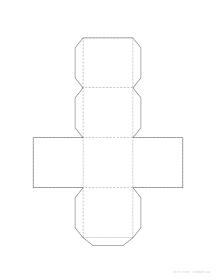
A net is a flat pattern that folds into a 3D shape. In maths lessons nets show how faces, edges and vertices fit together; at home they make gift boxes, party favours and dice.
Shapes
Cube. Six squares in the familiar cross layout.
Square pyramid. A square base with four equilateral triangles.
Triangular prism. Three squares and two equilateral triangles.
How to make one
- Print on card at 100%.
- Score the dashed lines with a blunt knife and ruler.
- Cut along the solid lines, including round the tabs.
- Fold every dashed line and glue the tabs inside.
Printing tips
Print at 100% / Actual size. For dice, a 20 mm cube is a good size; for gift boxes, 60 to 80 mm.
Popular net template sheets
Frequently asked questions
Which shapes are included?
A cube, a square-based pyramid with equilateral triangle faces, and a triangular prism with square sides and equilateral triangle ends.
How big can the box be?
You choose the edge length from 15 to 100 mm. If the net does not fit on the page it is reduced to fit; a 50 mm cube fits easily on Letter or A4.
What are the tabs for?
Glue tabs sit on alternate open edges; fold them under and glue them to the neighbouring face. Turn them off if you prefer to tape the edges.
What paper should I use?
Card of about 160 to 250 g/m² folds crisply and holds its shape. Score the dashed lines before folding.
Is this useful for teaching?
Yes. Nets show how a 3D shape is made from 2D faces, and counting faces, edges and vertices on the folded shape is a common geometry activity.
Can I make a gift box with a lid?
Make two cubes, one with a slightly larger edge, and cut the top face off each to make a box and a lid.
Last updated · About us