Variations
What prints with the starting settings
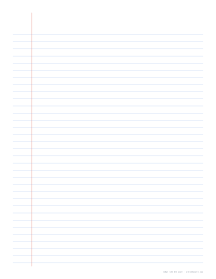
| Paper | US Letter — 215.9 × 279.4 mm (8.5 × 11 in) |
|---|---|
| Line spacing | 7.14 mm = 0.281″ |
| Ruling | College ruled |
| Writing lines on this page | 32 |
| Margins | 1/2″ |
| Line weight | 0.18 mm (bold 0.35 mm) |
| Print setting | Scale 100% / Actual size |
The default for students and offices
College ruling is what most people picture when they think of notebook paper. Its 7.1 mm line height suits handwriting that has settled into a consistent, medium size, which usually happens around middle school. From there it becomes the standard for high school notes, university lectures, lab write-ups and, outside education, for meeting notes, call logs and to-do lists at work.
The appeal is balance. You get noticeably more lines than wide ruled without the tightness of narrow ruling, so a page of lecture notes holds a lot without becoming hard to reread.
Printed sheets are also handy when the store-bought notebook runs out mid-term or when a class requires work on single sheets that can be handed in.
Making loose-leaf that works like the real thing
Printed college ruled paper is most useful as loose-leaf for a binder. Turn on the punch guides so the holes land in the left margin at standard three-ring spacing. If you print double-sided, also enable Alternate margins for binding; otherwise the back of each sheet will have its margin on the wrong side once punched.
For homework, the class header adds name, class, period and date lines at the top, which teachers often require. Students who type and then annotate by hand sometimes prefer the no-margin variant, which runs the lines edge to edge for maximum width.
Tips for neater notes
- Leave a blank line between topics. It costs little on a 32-line page and makes review much easier.
- Use the margin for keywords, dates or question marks so they stand out when you skim later.
- Date the top of every page, even continuation sheets; loose-leaf gets shuffled.
- If you write very small, try narrow ruled to fit four more lines per Letter page; if you are tutoring a younger sibling, print wide ruled instead.
Printing a semester’s supply
Set Pages in the PDF to 50 or 100 and switch on page numbers to keep notes in order. The vector PDF stays small, and every line prints crisp on inkjet or laser. Remember to choose Actual size in the print dialog; fit-to-page shrinks the ruling enough that it no longer matches store-bought paper you might mix it with.
More lined paper sheets
- Wide ruled paper (Letter & A4)
- Notebook paper (college ruled, with holes)
- A4 lined paper (8 mm feint with margin)
- Narrow ruled paper (Letter, A4 & Legal)
- Writing paper (wide lines for letters and stories)
- Genkō yōshi (Japanese manuscript paper)
- Legal pad paper (yellow, Legal & Letter)
- Seyès paper (French ruled)
- A5 lined paper for journals and planners
- Arabic lined paper (right-hand margin)
- Wongoji (Korean manuscript paper)
- Pitman ruled paper (1/2 inch lines)
Frequently asked questions
What is the line spacing of college ruled paper?
9/32 inch, about 7.1 mm. It sits between wide ruled (11/32 inch) and narrow ruled (1/4 inch).
How many lines does college ruled paper have?
A US Letter sheet here has 32 writing lines with half-inch margins, and A4 has 35. Header fields use some of the top space and reduce the count slightly; the spec table shows the exact figure for your settings.
Why is it called college ruled?
The name comes from its use by older students, who write smaller and want more lines per page than the wide ruling used in elementary school. Despite the name, it is the default in most middle and high schools today. It is also sold as medium ruled, the same 9/32 inch spacing.
Can I print college ruled paper on both sides?
Yes. Print double-sided and turn on Alternate margins for binding in Advanced options, so the wider margin falls on the binder side of both the front and the back.
Is college ruled good for Cornell notes?
The spacing is right, but the layout is not. Our Cornell notes template uses the same 9/32 inch ruling with a cue column and summary box already drawn in.
Last updated · About us