Variations
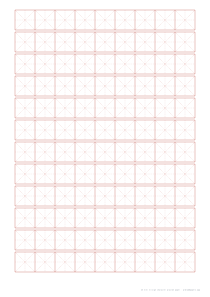
What prints with the starting settings
| Paper | A4 — 210 × 297 mm (8.27 × 11.69 in) |
|---|---|
| Boxes per page | 108 (12 rows × 9) |
| Box size | 20 mm |
| Margins | 10 mm |
| Line weight | 0.15 mm (bold 0.35 mm) |
| Print setting | Scale 100% / Actual size |
Guides for every direction
The mi zi ge grid divides each box into eight by adding diagonals to the central cross. The name comes from the character 米 (rice), whose shape the guides resemble. Because many strokes in Chinese calligraphy run diagonally, the extra guides make it easier to judge their angle, length and where they meet the centre.
Practising calligraphy
Start with single strokes in large boxes, then build up to characters, paying attention to where each stroke crosses the guides. Brush writers often place the printed grid under thin practice paper and write over it, so the guides show through without marking the finished work.
Printing tips
Print at 100% / Actual size. Use heavier paper if you will write directly on it with a brush.
More handwriting sheets
- First grade writing paper (3/4 inch lines)
- Kindergarten writing paper (1 inch lines)
- Cursive handwriting paper with slant lines
- Primary story paper
- Third grade handwriting paper (1/2 inch lines)
- Brush lettering practice sheets (28 mm lines)
- Tian zi ge (田字格) paper
- Copperplate calligraphy guide sheets (55° slant)
- Hindi writing practice paper
- Preschool writing paper (1 1/4 inch lines)
- Second grade writing paper (5/8 inch lines)
Frequently asked questions
When should I use mi zi ge instead of tian zi ge?
When strokes slant, as in the left-falling and right-falling strokes of 人 and 大, the diagonals show their angle and length. Calligraphy students often prefer mi zi ge for that reason.
Which box size is best for brush calligraphy?
Brush practice usually uses large boxes, 30 mm or more, to give the brush room. Choose up to 40 mm in the box size control.
What is hui gong ge?
A box with a smaller square inside it, used to judge how much space the central part of a character should occupy. It is one of the variants on this page.
Can I use this paper with a brush and ink?
Normal printer paper is thin for ink; print on heavier paper or place the print under translucent practice paper and use it as a guide.
Are pinyin lines available?
Yes, switch on Pinyin lines above each row in the advanced options.
Last updated · About us