Variations
What prints with the starting settings
| Paper | A4 — 210 × 297 mm (8.27 × 11.69 in) |
|---|---|
| Boxes per page | 192 (16 rows × 12) |
| Box size | 15 mm |
| Margins | 10 mm |
| Line weight | 0.15 mm (bold 0.35 mm) |
| Print setting | Scale 100% / Actual size |
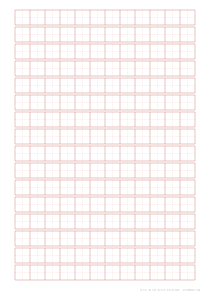
Learning to write characters in proportion
Chinese characters are built from strokes and components that must sit in balance within an imaginary square. Tian zi ge paper makes that square real and divides it into quarters. Children in mainland China learn to write on it from the first year of school, and it is the standard practice paper for learners of Mandarin worldwide.
How to practise
Write each new character several times along a row, watching where strokes cross the dashed guides. Many teachers have students trace the character in the first box, copy it in the next few, and then write it from memory. Pinyin lines above each row let you add the pronunciation with tone marks.
Printing tips
Print at 100% / Actual size. The guides are a lighter red than the box borders, the colour scheme used in Chinese exercise books; change the colours in the advanced options if you prefer grey.
More handwriting sheets
- First grade writing paper (3/4 inch lines)
- Kindergarten writing paper (1 inch lines)
- Cursive handwriting paper with slant lines
- Primary story paper
- Third grade handwriting paper (1/2 inch lines)
- Brush lettering practice sheets (28 mm lines)
- Copperplate calligraphy guide sheets (55° slant)
- Hindi writing practice paper
- Mi zi ge (米字格) paper
- Preschool writing paper (1 1/4 inch lines)
- Second grade writing paper (5/8 inch lines)
Frequently asked questions
What does 田字格 mean?
"Field-character grid": each box looks like the character 田 (field), a square divided into four by a cross. The cross is dashed so it guides without competing with the character.
How do the guides help?
They show where each stroke starts and ends relative to the centre, so components are balanced: the left and right halves of 好, the top and bottom of 字, and the centre stroke of 中.
What size box should I use?
15 mm is a good general size. Beginners and young children often start at 20 mm or larger; practised writers move down to 10 or 12 mm.
What are the pinyin lines?
A four-line band above each row, like small English handwriting lines, for writing the pinyin spelling with tone marks above each character.
How is it different from mi zi ge?
Mi zi ge (米字格) adds the two diagonals, which helps with slanting strokes. See mi zi ge paper.
Last updated · About us