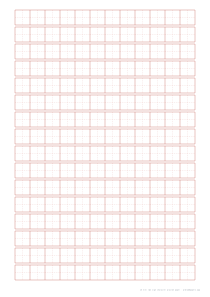
Why characters need a square
Every Chinese character, however many strokes it has, occupies the same square space. A character with three strokes and one with twenty are written the same size, and the strokes must be balanced within the square: not too far to one side, not crowded at the bottom. Practice grids make that invisible square visible.
The three common grids
田字格 (tián zì gé), the field grid. A square divided into four by a dashed horizontal and vertical line through the centre. The cross shows where the centre of the character is and helps place left-right and top-bottom components. It is the standard grid in Chinese primary schools.
米字格 (mǐ zì gé), the rice grid. The field grid plus two dashed diagonals. The diagonals give guidance for sweeping strokes and for characters built around a central point. It is popular for calligraphy and for learners who find balance difficult.
回宫格 (huí gōng gé), the box-in-a-box grid. Named for its resemblance to the character 回, it has a smaller square drawn inside the box, showing where the main body of the character should sit, with the outer ring for strokes that reach out. It is used in some calligraphy teaching.
- 田字格 tian zi gedashed cross
- 米字格 mi zi gecross and diagonals
- 回宫格 hui gong geinner square
- Plain boxesno guides
| Grid | Guides | Good for |
|---|---|---|
| 田字格 | cross | everyday writing, school |
| 米字格 | cross + diagonals | calligraphy, balancing complex characters |
| 回宫格 | inner square | centring, calligraphy |
| Plain boxes | none | tests, compositions, advanced writers |
Choosing a box size
- Children and beginners: 15–20 mm boxes give room to learn stroke shapes.
- Adults and students: 10–12 mm for everyday handwriting practice.
- Brush calligraphy: much larger, often 30 mm or more, or one large box per sheet.
The tian zi ge generator prints any of the grids at the size you choose, with optional pinyin lines above each row. Here is how many boxes fit a page at each size:
| Paper | 20 mm | 15 mm | 12 mm | 12 mm + pinyin |
|---|---|---|---|---|
| A4 | 108 (12 rows × 9) | 192 (16 rows × 12) | 285 (19 rows × 15) | 195 (13 rows × 15) |
| US Letter | 99 (11 rows × 9) | 180 (15 rows × 12) | 270 (18 rows × 15) | 180 (12 rows × 15) |
| B5 (JIS) | 80 (10 rows × 8) | 140 (14 rows × 10) | 221 (17 rows × 13) | 143 (11 rows × 13) |
How to practise with the grid
- Learn the stroke order first. Characters are written in a set order. The usual guidelines are top to bottom and left to right; horizontal before vertical where they cross; outside before inside, but closing an enclosure last; the centre before the sides in symmetrical characters; and small dots last. They have exceptions, so check a dictionary for each new character.
- Copy a model. Write the model character in the first box, or use a printed model, then copy it along the row.
- Watch the guide lines. Notice where each stroke crosses the dashed lines in the model and match it.
- Keep components in proportion. In a left-right character like 好, decide how much of the square each side takes before you start.
- Fade the guides. As you improve, move from mi zi ge to tian zi ge to plain boxes.
Related formats
Japanese students use genkō yōshi (genko yoshi paper) for compositions, a grid of plain squares written in columns, and Korean students use wongoji (wongoji paper). Both are about spacing and layout in essays rather than about the inner structure of each character.