Variations
What prints with the starting settings
| Paper | US Letter — 215.9 × 279.4 mm (8.5 × 11 in) |
|---|---|
| Writing height (top to baseline) | 15.88 mm = 5/8″ |
| Writing sets on this page | 8 |
| Midline (x-height) | 5/16″ |
| Margins | 1/2″ |
| Line weight | 0.25 mm (bold 0.35 mm) |
| Print setting | Scale 100% / Actual size |
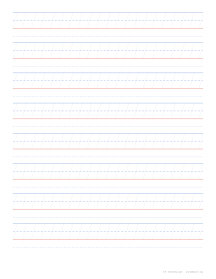
Slant guides that keep joined writing even
The hardest part of cursive is not the letter shapes but keeping every downstroke at the same angle. Without a reference, the slant drifts within a line: upright at the start, leaning by the end. This sheet adds faint diagonal guides at 75° across each writing set, about 9 mm apart. Line up the downstrokes of l, t and d with them and the whole line takes on one consistent rhythm.
The guides are deliberately pale grey-blue and thinner than the writing lines. They are there to glance at, not to trace, so they fade into the background once your pencil is moving. The red baseline, dashed midline and dotted descender line work just as they do on print practice paper.
Picking a size
- 5/8 inch (default): a good middle size for students learning cursive in elementary school. The lowercase zone is 5/16 inch (7.9 mm).
- 3/4 inch: more room for loops, useful for beginners and for children with larger handwriting.
- 1/2 inch: closer to everyday writing size; good for older students and adults working on a joined hand.
If cursive is your first time using a descender line, the third grade paper uses the same layout without diagonals for comparison.
Left-handed writers
The guides lean right, as school cursive does, but left-handers do not have to follow them exactly. Many left-handed writers are more comfortable with a more upright slant. Print the No slant guides version, or simply aim for a consistent angle of your own; evenness matters far more than the precise degree. Tilting the paper clockwise often helps left-handers see what they have just written.
To trace joined letters before writing freehand, the cursive tracing worksheet maker turns any words into dotted cursive on the same kind of lines.
A practice routine that works
Start each session with a line of slant strokes only, matching the guides. Then write joined pairs (an, en, in, on) before moving to words. Every few sessions, swap to the No slant guides variation for one page: if your letters still lean evenly, the habit is forming. When you want a formal script with shades and hairlines, move on to the more strongly slanted 55° copperplate paper.
Print at actual size. The diagonals use a fixed pale tint so they never compete with the writing lines; if they disappear on a draft-mode printout, switch the printer to normal or best quality rather than toner-saving mode.
More handwriting sheets
- First grade writing paper (3/4 inch lines)
- Kindergarten writing paper (1 inch lines)
- Primary story paper
- Third grade handwriting paper (1/2 inch lines)
- Brush lettering practice sheets (28 mm lines)
- Tian zi ge (田字格) paper
- Copperplate calligraphy guide sheets (55° slant)
- Hindi writing practice paper
- Mi zi ge (米字格) paper
- Preschool writing paper (1 1/4 inch lines)
- Second grade writing paper (5/8 inch lines)
Frequently asked questions
What angle should cursive writing slant?
School cursive usually leans gently to the right. The guides on this sheet are drawn at 75° from the baseline, a moderate forward slant that suits most school cursive styles. If you want a stronger, more formal lean, the generator also offers 65°, 55° and 52° guides.
Why 5/8 inch lines for cursive?
Cursive letters have loops above and below the lowercase zone, and connecting strokes need room to swing. 5/8 inch (15.9 mm) gives a 5/16 inch lowercase zone, comfortable for students around third and fourth grade. Younger beginners can use the 3/4 inch variation; teenagers and adults often prefer 1/2 inch.
How many lines of cursive fit on a page?
Eight sets on US Letter and nine on A4, each with a descender line. With the 1/2 inch variation you get ten on Letter and eleven on A4.
Do the slant lines go through the descender area?
No. The guides cross the space from the top line to the baseline only, so the area for tails stays clean and the page is less cluttered. Use the slant of the body of each letter to judge your descenders.
Can adults use this to improve their handwriting?
Yes. Adults retraining their hand often start at 1/2 inch with slant guides, write a page of joins such as "mmm", "ele" and "ouo", then switch to the no-guides variation to see if the slant holds without help.
Last updated · About us