Variations
What prints with the starting settings
| Paper | US Letter — 215.9 × 279.4 mm (8.5 × 11 in) |
|---|---|
| Writing lines | 5 |
| Writing height | 3/4″ |
| Margins | 1/2″ |
| Line weight | 0.25 mm (bold 0.35 mm) |
| Print setting | Scale 100% / Actual size |
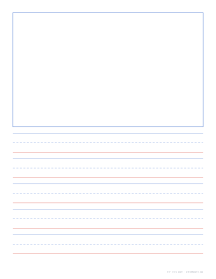
Draw first, then write
For children who are just learning to write, drawing is planning. A picture of the weekend, a favourite animal or a story’s beginning gives them something to say, and the lines underneath give them a place to say it. Story paper puts both on one page, which is why it is used in kindergarten, first and second grade classrooms for journals, writing workshops and homework.
Choosing the layout
A larger picture box suits the youngest children, who write a sentence or two. As writing grows, shrink the box and choose smaller line sets for more lines. The lines follow the familiar three-line pattern with a red baseline and a dashed midline.
Printing tips
Print at 100% / Actual size. Staple ten sheets for a journal, or print double-sided for a booklet.
More handwriting sheets
- First grade writing paper (3/4 inch lines)
- Kindergarten writing paper (1 inch lines)
- Cursive handwriting paper with slant lines
- Third grade handwriting paper (1/2 inch lines)
- Brush lettering practice sheets (28 mm lines)
- Tian zi ge (田字格) paper
- Copperplate calligraphy guide sheets (55° slant)
- Hindi writing practice paper
- Mi zi ge (米字格) paper
- Preschool writing paper (1 1/4 inch lines)
- Second grade writing paper (5/8 inch lines)
Frequently asked questions
What is primary story paper?
Paper with a large box for a drawing on the top half of the page and handwriting lines with a dashed midline underneath. Young children draw their story first, then write about it.
Which line size should I choose?
The default 3/4 inch lines suit kindergarten and first grade, when children write short sentences. The 1/2 inch variation fits more words for second graders and confident writers, and you can type any other height, such as 5/8 inch, in the generator.
Can I change how big the picture box is?
Yes, from 20 to 70 percent of the page.
How do children use the dashed midline?
Lowercase letters such as a and o reach the dashed line; tall letters and capitals reach the top line; letters such as g and y drop below the baseline.
Is it good for journals?
Yes. A stack of story paper stapled together makes a simple daily journal for early writers.
Last updated · About us