Variations
What prints with the starting settings
| Paper | US Letter — 215.9 × 279.4 mm (8.5 × 11 in) |
|---|---|
| Writing height (top to baseline) | 19.05 mm = 3/4″ |
| Writing sets on this page | 7 |
| Midline (x-height) | 3/8″ |
| Margins | 1/2″ |
| Line weight | 0.25 mm (bold 0.35 mm) |
| Print setting | Scale 100% / Actual size |
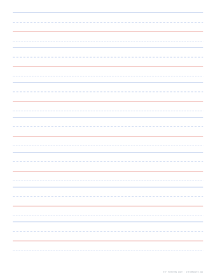
Why 3/4 inch suits six-year-olds
By first grade most children can form every letter; what they are learning now is consistency. Writing whole words and sentences on one-inch paper makes lines run out after two or three words, while half-inch paper is still too tight for unpractised hands. Three-quarter-inch sets sit in between. The midline falls at 3/8 inch (9.5 mm), so lowercase letters are still large and clear, and a short sentence fits across a Letter page.
This sheet also adds the fourth guide many first-grade programs introduce: a dotted descender line, half a set below the red baseline. With it in place children stop parking the tails of g and y on the line and start dropping them below, which is the habit that makes later third grade paper feel natural.
Setting it up for your class
Use the Name & date header for anything you will collect; it fits above the first set without losing a line on Letter. For a child who writes all letters at one height, try the shaded version: the tinted band makes the lowercase zone visible from across the table. If your program does not teach a separate descender line yet, the three-line version gives you ten sets per page instead of seven.
You can change the gap between sets in the generator too. The default is 1/4 inch (6.35 mm); widening it to 3/8 inch helps children whose capitals bump into the descenders above, at the cost of one set per page.
Pairing with other pages
Many first-grade teachers keep two papers in rotation: this guided sheet for handwriting lessons and copywork, and a plainer sheet for journal entries where ideas matter more than letter size. If a few students are still struggling with letter formation, give them the one-inch kindergarten paper for a few weeks; the identical line colours make the switch back painless.
Printing a stack
Set Pages in the PDF to the size of your class, switch on page numbers if you are binding a writing journal, and print at 100%. One set should measure exactly 3/4 inch from top line to red line. If your school copier lightens fine lines, print the master on a laser printer and choose a darker line colour in Advanced options.
More handwriting sheets
- Kindergarten writing paper (1 inch lines)
- Cursive handwriting paper with slant lines
- Primary story paper
- Third grade handwriting paper (1/2 inch lines)
- Brush lettering practice sheets (28 mm lines)
- Tian zi ge (田字格) paper
- Copperplate calligraphy guide sheets (55° slant)
- Hindi writing practice paper
- Mi zi ge (米字格) paper
- Preschool writing paper (1 1/4 inch lines)
- Second grade writing paper (5/8 inch lines)
Frequently asked questions
What size lines are used in first grade?
A common choice is a 3/4 inch (19 mm) writing height from top line to baseline, with the midline at 3/8 inch. It is a step down from the one-inch sets many kindergartens use, and the size most first grade handwriting programs settle on for the whole year.
How many lines fit on one page?
Letter paper with half-inch margins holds seven sets including the descender space; A4 holds eight. Turn off the descender line and Letter fits ten sets, A4 eleven.
What is the dotted line below the red line for?
It marks how far the tails of g, j, p, q and y should drop. It sits half a set height (3/8 inch) below the baseline, the same depth as the lowercase zone above it, so tails come out in proportion to the letters.
Will the header push lines off the page?
On Letter the name and date header still leaves room for all seven sets. On A4 you go from eight sets to seven.
Can I use this paper for journal writing with a picture box?
Switch Orientation to landscape for a wider line, or print a blank page with a border for the picture and staple the two together. Many teachers prefer that over a combined sheet because children need more writing room as the year goes on.
Last updated · About us