Variations
What prints with the starting settings
| Paper | US Letter — 215.9 × 279.4 mm (8.5 × 11 in) |
|---|---|
| Writing height (top to baseline) | 12 mm = 0.472″ |
| Writing sets on this page | 11 |
| Midline (x-height) | 0.236″ |
| Margins | 1/2″ |
| Line weight | 0.25 mm (bold 0.35 mm) |
| Print setting | Scale 100% / Actual size |
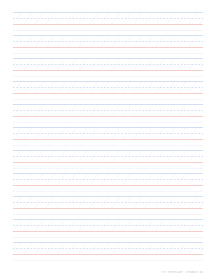
Guide lines for the pointed pen
Copperplate is built from a small set of strokes: hairline upstrokes, shaded downstrokes, ovals and compound curves. Each one depends on hitting two things exactly, the right height and the right angle. This sheet gives you both. The solid top line marks the height of ascenders such as b, h and l; the dashed line marks the x-height; the red line is the baseline; and the dotted line below marks how far descenders drop. Steep 55° guides cross the ascender and x-height zones about 9 mm apart, so every shaded downstroke has a line to run parallel to.
Because the zones are equal, the sheet is also a quick way to test consistency. If your loops on l and h overshoot the top line while your x-height stays put, the problem is pressure release on the upstroke, not your eye.
Choosing the variation
- Spencerian 52° suits the lighter, more slanted Spencerian hand and some ornamental business scripts.
- Larger 7.5 mm is the one to use for drills: rows of ovals, push-pull strokes and compound curves.
- Smaller 5 mm is for copying out quotes and envelopes once letters are steady.
- Shaded x-height band helps when your round letters keep creeping above the dashed line.
If you are still learning to join letters at all, cursive paper with its gentler 75° slant is a better first step. For brush pens, use the larger brush lettering sheets.
Building a drill sheet
A typical session runs from simple to complex: a line of hairline entrance strokes, a line of shaded downstrokes, then ovals, then the lowercase letters built from them (i, u, n, m, o, a). Write each drill across the full width of the sheet so you can compare the first stroke with the last. Keep the paper rotated so the slant guides point straight toward you; that is what the oblique holder is for.
Printing and paper
Print at Actual size and measure one set: from top line to baseline should be exactly 12 mm. Use the best print quality your printer offers so the faint slant guides stay crisp. If you are writing directly on the printout, choose a smooth, heavier paper and test your ink in a corner first. Alternatively, print one guide sheet and place it under thin layout or tracing paper; the lines show through and you can reuse the same guide many times.
More handwriting sheets
- First grade writing paper (3/4 inch lines)
- Kindergarten writing paper (1 inch lines)
- Cursive handwriting paper with slant lines
- Primary story paper
- Third grade handwriting paper (1/2 inch lines)
- Brush lettering practice sheets (28 mm lines)
- Tian zi ge (田字格) paper
- Hindi writing practice paper
- Mi zi ge (米字格) paper
- Preschool writing paper (1 1/4 inch lines)
- Second grade writing paper (5/8 inch lines)
Frequently asked questions
Why are copperplate guide lines slanted at 55 degrees?
Copperplate, also called English roundhand or engrosser's script, is traditionally written with a strong forward lean. 55° from the baseline is the angle most commonly quoted for it, and it is what the oblique pen holder is designed to make comfortable. Spencerian script usually leans slightly further (a lower angle from the baseline), which is why there is a 52° variation.
What x-height should a beginner use for copperplate?
Many teachers suggest starting around 5–7 mm. This sheet uses 6 mm, large enough to see the swell of each shaded stroke but small enough for a standard pointed nib to fill with one stroke. Move to 5 mm once your pressure control is consistent.
What are the proportions of the ruling?
Each set has three equal zones, 1:1:1, so ascenders, x-height and descenders are all 6 mm. Many historical exemplars use taller loops than that, in ratios such as 3:2:3, so treat this as a practice ruling. You can approximate a taller ratio by ignoring the dashed line and choosing a larger writing height.
Will the paper take ink from a pointed pen?
That depends on the paper you print on, not the template. Ordinary copier paper often feathers with iron gall or walnut ink. A smooth laser paper of 90–120 g/m² (24–32 lb) usually works much better, and many calligraphers print guide sheets and slip them under a translucent layout pad instead.
How many lines of practice fit on one sheet?
Eleven sets on Letter and twelve on A4 at the default size, each with its own descender zone. The 5 mm variation fits twelve on Letter and fourteen on A4.
Last updated · About us