Variations
What prints with the starting settings
| Paper | US Letter — 215.9 × 279.4 mm (8.5 × 11 in) |
|---|---|
| Writing height (top to baseline) | 12.7 mm = 1/2″ |
| Writing sets on this page | 10 |
| Midline (x-height) | 1/4″ |
| Margins | 1/2″ |
| Line weight | 0.25 mm (bold 0.35 mm) |
| Print setting | Scale 100% / Actual size |
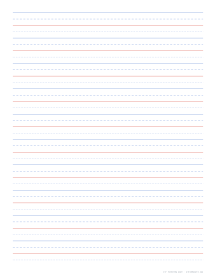
The last step before plain lined paper
By third grade the job of handwriting paper changes. Children already know where letters start and stop; now they need to write paragraphs at a size close to what they will use in notebooks, without losing the proportion between tall and short letters. Half-inch sets do that. The lowercase zone is 1/4 inch (6.35 mm), still larger than most adult handwriting but close enough that the move to ruled paper is a small step, and the descender line sits another 1/4 inch below the baseline.
Ten sets on a Letter page is enough for a short paragraph, a spelling list or a set of copywork sentences. A4 fits eleven. The sets are close enough together that a page reads like a page of writing rather than a drill sheet, which older students appreciate, yet the dashed midline still catches the common habit of letting small letters grow as a sentence goes on. Because each set has its own top line, students still get the feedback that tall letters should touch it, something ordinary ruled paper cannot show.
Using the variations
- Name, date & subject suits classrooms where work is sorted into subject folders or portfolios.
- Bridge size 5/8 inch is useful for a mixed-ability class: hand it to students who find 1/2 inch cramped while the rest of the room moves on.
- Tighter rows keeps every guide but closes the gap between sets, fitting an extra set per page for longer writing. Leave the default gap for students whose capitals still collide with the line above.
Assessing handwriting on this sheet
Because every zone is marked, the sheet doubles as a quick assessment tool. Ask students to copy the same sentence at the start and end of a unit, then compare three things: do tall letters reach the top line, do small letters stop at the midline, and do descenders drop to the dotted line instead of resting on the baseline. Those three checks show progress clearly to students and parents alike.
From here to notebooks
A good way to bridge to wide ruled paper is to alternate: copywork on this sheet, free writing on wide ruled lines. When a student’s letters stay even on the plain lines, the guided version has done its work. For cursive units, the cursive handwriting paper adds slant guides at a slightly larger 5/8 inch.
Print at 100% scale and check that one set measures 1/2 inch from top line to baseline. If you print double-sided, use paper of at least 24 lb (90 g/m²) so pencil pressure does not show through.
More handwriting sheets
- First grade writing paper (3/4 inch lines)
- Kindergarten writing paper (1 inch lines)
- Cursive handwriting paper with slant lines
- Primary story paper
- Brush lettering practice sheets (28 mm lines)
- Tian zi ge (田字格) paper
- Copperplate calligraphy guide sheets (55° slant)
- Hindi writing practice paper
- Mi zi ge (米字格) paper
- Preschool writing paper (1 1/4 inch lines)
- Second grade writing paper (5/8 inch lines)
Frequently asked questions
What size handwriting lines do third graders use?
Typically 1/2 inch (12.7 mm) from top line to baseline, with the midline at 1/4 inch. It is often the last guided size before students switch to ordinary wide ruled paper, with lines 11/32 inch (8.7 mm) apart.
How many writing sets fit on a page?
Ten on US Letter and eleven on A4 at the default 1/4 inch gap. Adding a name, date and subject header leaves nine on Letter and ten on A4.
Is this the right paper for learning cursive?
The size is right, but cursive practice benefits from slant guides. Our cursive paper uses the same three-line layout with light 75° guide lines across each set.
Should second graders use this size?
It depends on the program. Many second-grade classrooms still use 5/8 or 3/4 inch sets for most of the year and move to 1/2 inch in spring. The 5/8 inch variation above makes a gentle in-between step.
Can I make the dashed midline lighter so it doesn't distract?
Yes. Open Advanced options and pick a lighter line colour, or a thinner line weight. The red baseline keeps its colour so the important line stays obvious.
Last updated · About us