Variations
What prints with the starting settings
| Paper | US Letter — 215.9 × 279.4 mm (8.5 × 11 in) |
|---|---|
| Writing height (top to baseline) | 25.4 mm = 1″ |
| Writing sets on this page | 7 |
| Midline (x-height) | 1/2″ |
| Margins | 1/2″ |
| Line weight | 0.25 mm (bold 0.35 mm) |
| Print setting | Scale 100% / Actual size |
Built for first letters
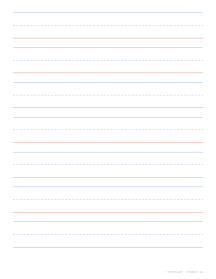
Kindergarten paper has one job: give a child enough room to build each letter from big, separate strokes. Each set here is a full inch from the top line down to the baseline, with the dashed midline exactly halfway at 1/2 inch (12.7 mm). Tall letters such as b, d, h and k reach the top line; small ones such as a, m and o stop at the midline. The baseline is drawn in red so “sit on the red line” becomes an instruction a five-year-old can follow.
The gap between sets is about 3/8 inch (9.5 mm). That blank strip keeps a row of capitals from crashing into the tails of the row above, and it gives small hands somewhere to rest. On Letter you get seven sets, which is about right for a single sentence or a name written several times over. A4 is a little taller and fits eight. Seven or eight lines may look sparse to an adult, but for a five-year-old a full page of carefully formed letters is a real accomplishment, and a page that can actually be finished keeps motivation high.
Choosing a variation
- Name & date turns the sheet into a worksheet you can collect and file. It is the most useful option for take-home practice.
- Shaded middle zone helps children who write every letter the same height. The tint marks where lowercase letters belong.
- Extra large 1 1/4 inch suits pre-K, children with motor-planning difficulties, and anyone using thick crayons or markers.
- Descender line adds a dotted guide below the baseline. Use it once your class starts writing g, p and y in words.
When the class is ready for smaller letters, step down to first grade paper, which keeps the same three-line layout at 3/4 inch.
Printing tips for the classroom
Print at Actual size so a set measures exactly one inch; a ruler held against the margin is the quickest check. Plain copier paper works, though a heavier 24 lb (90 g/m²) sheet stands up better to repeated erasing. For a laminated practice mat, print one page, laminate it and use a dry-erase marker. If your copier makes the dashed midline too faint, open Advanced options and choose a darker line colour before you print the master.
More handwriting sheets
- First grade writing paper (3/4 inch lines)
- Cursive handwriting paper with slant lines
- Primary story paper
- Third grade handwriting paper (1/2 inch lines)
- Brush lettering practice sheets (28 mm lines)
- Tian zi ge (田字格) paper
- Copperplate calligraphy guide sheets (55° slant)
- Hindi writing practice paper
- Mi zi ge (米字格) paper
- Preschool writing paper (1 1/4 inch lines)
- Second grade writing paper (5/8 inch lines)
Frequently asked questions
How many writing lines are on a page of kindergarten paper?
With half-inch margins a US Letter page holds seven one-inch writing sets. A4 with 10 mm margins fits eight. Adding the name and date header takes a little space from the top, leaving seven sets on both sizes.
What size lines do kindergarteners write on?
Most kindergarten paper uses a writing height of about 1 inch (25 mm) from top line to baseline, split by a dashed midline at 1/2 inch. Some classrooms start younger children on even bigger sets, which is what the 1 1/4 inch variation is for.
Why is there no line for the tails of g and y?
Many kindergarten programs teach the descender as simply "going below the red line" and leave the space under it open so the page looks less busy. If your curriculum shows a fourth line, switch on the descender variation; it fits five sets on Letter and six on A4.
What does the shaded middle zone do?
It fills the band between the dashed midline and the baseline with a pale blue tint. Lowercase letters such as a, c, e, m and o live entirely inside that band, so children can see at a glance how tall they should be.
Can I print a whole week's worth at once?
Yes. Open Advanced options, set Pages in the PDF to the number you need (for example 25 for a class), and print once. Every page is identical, and the file stays small because it is vector.
Last updated · About us