Variations
What prints with the starting settings
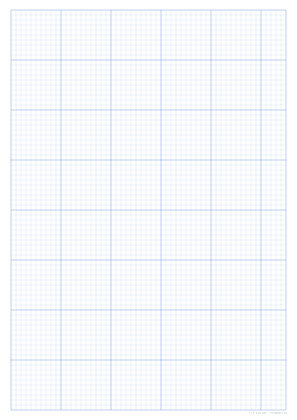
| Paper | A3 — 297 × 420 mm (11.69 × 16.54 in) |
|---|---|
| Square size | 5 mm = 0.197″ |
| Squares per inch | 5.08 |
| Squares per cm | 2 |
| Grid on this page | 55 × 80 squares |
| Margins | 10 mm |
| Line weight | 0.18 mm (bold 0.35 mm) |
| Print setting | Scale 100% / Actual size |
Why go up to A3
A3 doubles the drawing area of A4 while keeping the same proportions, which makes it the natural next step when a graph or plan feels cramped. Architecture and design students use it for site plans and room layouts at 1:100 or 1:50. Teachers print class timelines, number lines and data displays that can be read from the back of a room. Gardeners and allotment holders map beds and paths over a whole season’s plot. Engineers use A3 for schematics that would need tiny text on A4.
Because A3 is exactly two A4 pages, you can also design on A3 and reduce to A4 at 71% for handouts, keeping every proportion intact.
Choosing a grid for a big sheet
The default here is a 5 mm grid with a bold line every 5 cm, giving 55 × 80 squares in portrait. The bold blocks act as a coarse grid for laying out the drawing, and the fine squares for detail. Other good options:
- 1 cm squares: 27 × 40 in portrait or 40 × 27 in landscape. Clear from a distance, ideal for wall charts.
- 1 mm drafting grid: 277 × 400 squares with bold centimeters, the traditional metric graph paper for precise technical drawings.
- 2 mm: a middle ground for scientific plots. See 2 mm graph paper for scales that read well.
Landscape uses
Landscape A3 is the classic format for project timelines, site plans of wide plots, elevations of a building’s long side and posters. With a 1 cm grid you get 40 columns, enough for a full school term week by week or forty years of data in a history project.
Printing A3
Many home printers stop at A4, but A3 inkjets are common in studios, and office copiers usually accept A3 in a separate tray. Choose A3 as the paper size in the print dialog and set scaling to Actual size. On a large sheet, a 1% error is 4 mm over the length, which is enough to skew a scale drawing. Run the calibration wizard for the A3 printer you use.
More graph paper sheets
- 1/4 inch graph paper (Letter & A4)
- 5 mm graph paper (A4, Letter & A3)
- 1/8 inch graph paper (Letter, A4 & Legal)
- 1 cm graph paper (centimeter squares)
- Engineering paper (5 squares per inch)
- 1 inch graph paper (Letter, A4 & 11×17)
- A4 graph paper (5 mm, 1 cm, 2 mm & more)
- 1/2 inch graph paper (large squares)
- 1 mm graph paper (millimetre paper)
- 11×17 graph paper (Tabloid & Ledger)
- 2 mm graph paper (bold every centimeter)
- Quilting graph paper
- Legal size graph paper (8.5 × 14 in)
Frequently asked questions
How big is A3 paper?
A3 is 297 × 420 mm (about 11.69 × 16.54 inches), exactly two A4 sheets placed side by side. Its long side is a little shorter than US Tabloid, and its short side a little wider.
How many squares fit on A3 graph paper?
With 10 mm margins the grid is 55 × 80 squares at 5 mm, 27 × 40 at 1 cm and 277 × 400 at 1 mm. In landscape the numbers swap, so a 1 cm grid becomes 40 columns by 27 rows.
My printer only takes A4. Can I still use A3 graph paper?
You can send it to a copy shop or office copier, most of which handle A3. Printing an A3 PDF on A4 shrinks it to about 71%, so the squares would no longer be their stated size.
What scale should I use for a house plan on A3?
At 1:100 each centimeter is one meter, so the 1 cm grid holds a 27 × 40 m plot. At 1:50 each 5 mm square is 25 cm, which suits a single floor of a house in more detail.
Is A3 the same as 11×17?
No. Tabloid is 279.4 × 431.8 mm, so it is about 18 mm narrower and 12 mm longer than A3. If you are in North America, use 11×17 graph paper so the grid fits your paper.
Last updated · About us