Variations
What prints with the starting settings
| Paper | A4 — 210 × 297 mm (8.27 × 11.69 in) |
|---|---|
| Square size | 5 mm = 0.197″ |
| Squares per inch | 5.08 |
| Squares per cm | 2 |
| Grid on this page | 38 × 55 squares |
| Margins | 10 mm |
| Line weight | 0.18 mm (bold 0.35 mm) |
| Print setting | Scale 100% / Actual size |
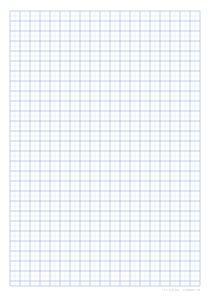
The international standard sheet
A4 is part of the ISO 216 series, the paper system used across Europe, Asia, Africa, Oceania and most of South America. Its sides have a ratio of 1 to √2, which means folding or cutting an A4 sheet in half gives two A5 sheets with exactly the same shape. That property is why A-series grids enlarge and reduce so neatly on a photocopier: an A4 diagram copied at 141% fills an A3 page with nothing cropped.
If you live outside the US and Canada, A4 is almost certainly the paper in your printer, so it is the safest default for school, office and home use.
Square sizes that fit A4 well
With 10 mm margins the printable area is 190 × 277 mm. Metric spacings divide that cleanly:
- 5 mm gives 38 × 55 squares, the standard squared-paper look. The default bolds every centimeter.
- 1 cm gives 19 × 27, good for primary math, bar charts and large diagrams. In landscape it becomes 27 × 19.
- 2 mm gives a 95 × 138 grid with bold centimeters, the usual choice for lab graphs.
- 1/4 inch fits 29 × 43, for families following US textbooks while living abroad.
Every option keeps the grid centered, so the margins come out equal even when the page does not divide into whole squares.
When to turn the page sideways
Landscape A4 suits time-series graphs, wide timelines, Gantt-style project plans and room layouts that are longer than they are deep. A 1 cm grid turned sideways gives 27 columns, enough for a month of daily readings with space for labels. Choose the landscape variation, or use the orientation switch in the generator for any spacing.
Printing A4 accurately
Check that your print dialog shows A4 as the paper size, not Letter, and set scaling to Actual size. Measure across 10 one-centimeter blocks: they should cover 100 mm. If you also need ruled pages to match, A4 lined paper is ready on the same sheet size. For the full family of sizes and where each is used, see our guide to paper sizes.
More graph paper sheets
- 1/4 inch graph paper (Letter & A4)
- 5 mm graph paper (A4, Letter & A3)
- 1/8 inch graph paper (Letter, A4 & Legal)
- 1 cm graph paper (centimeter squares)
- Engineering paper (5 squares per inch)
- 1 inch graph paper (Letter, A4 & 11×17)
- 1/2 inch graph paper (large squares)
- 1 mm graph paper (millimetre paper)
- 11×17 graph paper (Tabloid & Ledger)
- 2 mm graph paper (bold every centimeter)
- A3 graph paper for large drawings and plans
- Quilting graph paper
- Legal size graph paper (8.5 × 14 in)
Frequently asked questions
What size is A4 paper?
A4 measures 210 × 297 mm, or about 8.27 × 11.69 inches. Compared with US Letter it is 6 mm narrower and 18 mm taller, so a Letter PDF printed on A4 either leaves a gap or gets scaled.
How many squares fit on A4 graph paper?
With 10 mm margins: 38 × 55 squares at 5 mm, 19 × 27 at 1 cm, 95 × 138 at 2 mm and 29 × 43 at 1/4 inch. Landscape swaps the two numbers.
Which square size suits A4 best?
5 mm is the most common choice and fills the page evenly at 190 × 275 mm of grid. Use 1 cm for young children, 2 mm for science graphs, and 1/4 inch only if you are following a US worksheet.
Can I print A4 graph paper on a Letter printer?
Only by shrinking it, which spoils the square size. If your printer is loaded with Letter, pick Letter in the size menu instead; the generator will recalculate the grid to fit while keeping the squares exact.
How do A5 and A3 relate to A4?
Every A size is half the one before it. Two A5 sheets make one A4, and two A4 sheets side by side make one A3. All share the same proportions, so a drawing scales from one to another without distortion.
Last updated · About us