Variations
What prints with the starting settings
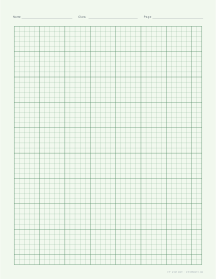
| Paper | US Letter — 215.9 × 279.4 mm (8.5 × 11 in) |
|---|---|
| Square size | 5.08 mm = 1/5″ |
| Squares per inch | 5 |
| Squares per cm | 1.969 |
| Grid on this page | 37 × 47 squares |
| Margins | 1/2″ |
| Line weight | 0.18 mm (bold 0.35 mm) |
| Print setting | Scale 100% / Actual size |
Why engineers use five to the inch
Engineering paper, also called engineering computation paper or simply “engineering pad”, is the standard writing surface in many American engineering, physics and drafting courses. The ruling is five squares per inch with a bold line at each whole inch. Fifths divide neatly into decimals, so a sketch drawn at one square = 0.2 inch or one square = 2 feet scales without fractions.
Instructors like it because it imposes order on problem sets, and some courses ask for homework to be submitted on it. A typical page has a header block at the top (name, course, date, page number), a clear statement of the given values, a free-body diagram drawn on the grid, then the equations worked down the page one line per row. The grid keeps units, arrows and alignment tidy, and graders find answers faster. Many students also box the final answer and draw a double line under it, which the bold inch rules make easy to keep straight.
Green or white
Store-bought pads are almost always pale green, with the grid printed on the reverse so it shows through faintly. This page reproduces that look by default: a light green page, soft green lines and darker inch rules, with a header for name, class and page number. The tinted page uses more ink, so for a large stack of homework sheets choose White paper, grey grid, which keeps the header and copies cleanly.
Setting up a problem-set pad
- The header has name, class and page fields; page numbers can also be added automatically in Advanced options.
- Set Pages in the PDF to cover a whole semester’s homework; the vector file stays small.
- Switch on alternate margins for binding if you plan to punch the sheets and keep them in a binder.
- Tabloid gives a 50 × 77 grid (50 × 80 without the header) for large layouts or circuit schematics that would be cramped on Letter.
Print at Actual size so five squares measure exactly one inch. Our guide to engineering paper explains the history and conventions in more depth, including how to lay out a computation page.
More graph paper sheets
- 1/4 inch graph paper (Letter & A4)
- 5 mm graph paper (A4, Letter & A3)
- 1/8 inch graph paper (Letter, A4 & Legal)
- 1 cm graph paper (centimeter squares)
- 1 inch graph paper (Letter, A4 & 11×17)
- A4 graph paper (5 mm, 1 cm, 2 mm & more)
- 1/2 inch graph paper (large squares)
- 1 mm graph paper (millimetre paper)
- 11×17 graph paper (Tabloid & Ledger)
- 2 mm graph paper (bold every centimeter)
- A3 graph paper for large drawings and plans
- Quilting graph paper
- Legal size graph paper (8.5 × 14 in)
Frequently asked questions
What is engineering paper?
It is graph paper ruled 5 squares per inch with a heavier line every inch. Commercial pads are traditionally pale green, with the grid printed on the back so it shows faintly through to the front. Students write on the smooth front, and the grid stays visible without dominating the work.
Why is engineering paper green?
It is a long-standing convention. Pale green is often said to be easier on the eyes than bright white, and the soft color keeps the grid in the background so handwriting and diagrams stand out. This page prints green by default; choose White paper, grey grid to save ink.
How many squares are on a sheet of engineering paper?
On Letter with half-inch margins and the header, the grid is 37 × 47 squares (37 × 50 without the header). A4 fits 37 × 52, Legal 37 × 62 and Tabloid 50 × 77 with the header.
Can I print the grid on the back like a real pad?
A home printer cannot print through the paper, but you can get a similar effect with the Faint grid variation, which keeps the lines light enough that your work reads first. For a plain white grid without the pad styling, see 5 squares per inch graph paper.
Is 1/5 inch the same as 5 mm?
Almost. 1/5 inch is 5.08 mm, so the two grids drift apart by about 1.6% over a page. If you work in metric units, use 5 mm graph paper so your ruler agrees with the squares.
Last updated · About us