Variations
What prints with the starting settings
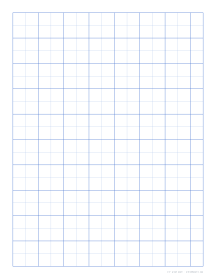
| Paper | US Letter — 215.9 × 279.4 mm (8.5 × 11 in) |
|---|---|
| Square size | 12.7 mm = 1/2″ |
| Squares per inch | 2 |
| Squares per cm | 0.787 |
| Grid on this page | 15 × 20 squares |
| Margins | 1/2″ |
| Line weight | 0.18 mm (bold 0.35 mm) |
| Print setting | Scale 100% / Actual size |
Big squares for small hands
Young children write large, and a quarter-inch box is simply too tight for a five-year-old’s numeral. Half-inch squares give each digit room, which is why many kindergarten, first and second grade teachers use this paper for early addition and subtraction. Writing one digit per square keeps ones under ones and tens under tens, so the idea of place value becomes something students can see. The same sheet doubles as a simple hundred-chart builder: children write 1 to 10 across a row, then continue down the page, and patterns such as counting by fives start to jump out.
The grid also works for picture graphs and bar graphs: one square per vote or per item, colored in with crayon. The landscape variation turns the page into 20 columns by 15 rows on Letter, enough for a class survey with a dozen categories.
Beyond the classroom
Adults reach for large squares when the drawing, not the writing, needs space:
- Quilters sketch blocks at one square per inch and color them to test fabric placement.
- Gardeners plan raised beds where each square is six inches or a foot of soil.
- Teachers of students with low vision or motor challenges use it in place of standard graph paper.
- Game designers draft board layouts and tile placements before cutting cardstock.
Because the squares are large, light dashed lines often look cleaner than solid ones, especially after coloring. Try the Dashed light lines variation.
Making a classroom set
Add the Student name and date header, then open Advanced options and set Pages in the PDF to your class size so each child gets a sheet from one print job. If the page will be colored heavily, choose a slightly heavier paper in your printer settings. Markers bleed less on 24 lb (90 g/m²) stock, and the grid lines stay crisp under a layer of crayon.
Always print at Actual size: two squares should measure exactly one inch. If they come out short, your print dialog is scaling the page; our guide to printing at actual size shows where the setting hides on each device.
More graph paper sheets
- 1/4 inch graph paper (Letter & A4)
- 5 mm graph paper (A4, Letter & A3)
- 1/8 inch graph paper (Letter, A4 & Legal)
- 1 cm graph paper (centimeter squares)
- Engineering paper (5 squares per inch)
- 1 inch graph paper (Letter, A4 & 11×17)
- A4 graph paper (5 mm, 1 cm, 2 mm & more)
- 1 mm graph paper (millimetre paper)
- 11×17 graph paper (Tabloid & Ledger)
- 2 mm graph paper (bold every centimeter)
- A3 graph paper for large drawings and plans
- Quilting graph paper
- Legal size graph paper (8.5 × 14 in)
Frequently asked questions
How many 1/2 inch squares fit on a page?
On Letter with half-inch margins the grid is 15 × 20 squares (300 in all). A4 with 10 mm margins gives 14 × 21, and Legal stretches to 15 × 26.
What grade level is 1/2 inch graph paper for?
It is common in the early elementary years, roughly kindergarten through second or third grade, when digits are still written large. Once handwriting shrinks, most students move to 1/4 inch or 1 cm squares.
Can I use it to design quilt blocks?
Yes. Let each square stand for one inch or two inches of finished fabric. A 12-inch block drawn at one square per inch fills 12 × 12 squares, which fits on a Letter page with space left for notes.
Why is there a bold line every two squares?
Two half-inch squares equal one inch, so the bold lines mark whole inches. That helps when you use the sheet for measuring. For counting games or coloring, the Even grid variation removes them.
Is there a metric equivalent?
The nearest round metric size is 1 cm, slightly smaller at 10 mm versus 12.7 mm. Teachers outside the US often use 1 cm graph paper for the same purposes.
Last updated · About us