Variations
What prints with the starting settings
| Paper | US Letter — 215.9 × 279.4 mm (8.5 × 11 in) |
|---|---|
| Square size | 3.18 mm = 1/8″ |
| Squares per inch | 8 |
| Squares per cm | 3.15 |
| Grid on this page | 60 × 80 squares |
| Margins | 1/2″ |
| Line weight | 0.18 mm (bold 0.35 mm) |
| Print setting | Scale 100% / Actual size |
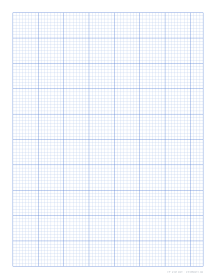
What a fine eighth-inch grid is for
The 1/8 inch grid packs 64 squares into every square inch, which makes it the go-to sheet when detail matters more than handwriting room. Architects and remodelers use it at 1/8 inch = 1 foot to fit an entire house, garage and lot on a single sheet; the half-size scale keeps rooms in proportion while leaving space around the plan. Woodworkers and model builders draw parts at full size and read dimensions to the nearest eighth, the same increment marked on any tape measure.
It is also a favorite for pixel art, sprite design and knitting-style charts where each square stands for one pixel or stitch, and for lab and finance notebooks where many narrow columns of figures need to line up.
Getting the bold lines right
On such a dense mesh, a heavier line every inch is what keeps you from losing count. The default here bolds every 8th line, so each block is exactly one inch square and you can measure without a ruler. If your drawing works in half inches, choose the Bold every half inch variation. For artwork that you plan to ink and scan, the pale grey version is easier to erase visually or remove in an image editor.
Printing a fine grid cleanly
Thin lines at 3 mm intervals can look muddy on a worn inkjet. A few adjustments help:
- Print from the vector PDF, not a PNG, so the lines stay sharp at any printer resolution.
- If the grid looks too dark, open Advanced options and lighten the line color rather than reducing the line weight below 0.15 mm.
- Choose Actual size in the print dialog, then measure 8 squares; they should span exactly 1 inch (25.4 mm). A 3% error is easy to miss on a fine grid but adds up across a full floor plan, so run the printer calibration if anything is off.
Legal paper gives you 104 rows instead of 80, handy for long timelines, tall elevations and multistory sections. Select it from the size buttons above, and the spec table will update to match.
More graph paper sheets
- 1/4 inch graph paper (Letter & A4)
- 5 mm graph paper (A4, Letter & A3)
- 1 cm graph paper (centimeter squares)
- Engineering paper (5 squares per inch)
- 1 inch graph paper (Letter, A4 & 11×17)
- A4 graph paper (5 mm, 1 cm, 2 mm & more)
- 1/2 inch graph paper (large squares)
- 1 mm graph paper (millimetre paper)
- 11×17 graph paper (Tabloid & Ledger)
- 2 mm graph paper (bold every centimeter)
- A3 graph paper for large drawings and plans
- Quilting graph paper
- Legal size graph paper (8.5 × 14 in)
Frequently asked questions
How many 1/8 inch squares fit on a Letter page?
With half-inch margins the grid is 60 squares across and 80 down, or 4,800 squares in total. On A4 with 10 mm margins you get 59 × 87, and on Legal paper 60 × 104.
What scale works best on 1/8 inch graph paper?
The common architectural scale is 1/8 inch = 1 foot, which fits a whole house footprint on one sheet. A 40 × 60 ft floor plan uses 40 × 60 squares and still leaves room in the margins for notes.
Is 1/8 inch graph paper too small to write on?
For most handwriting, yes. A single letter needs about two squares each way, so this grid suits drawing and plotting rather than notes. For writing, 1/4 inch or 5 mm squares are more comfortable.
Why does the bold line fall every 8 squares?
Eight eighth-inch squares make exactly one inch, so the heavier lines mark whole inches and let you measure straight off the page. Change Bold line every to 4 for half inches or 0 to remove them.
What is 1/8 inch in millimeters?
1/8 inch is 3.175 mm, so roughly 3.15 squares fit in each centimeter. If you need a round metric grid of similar density, 2 mm graph paper is a little finer and 3 mm a little coarser.
Last updated · About us