Variations
What prints with the starting settings
| Paper | Tabloid / Ledger (11×17) — 279.4 × 431.8 mm (11 × 17 in) |
|---|---|
| Square size | 6.35 mm = 1/4″ |
| Squares per inch | 4 |
| Squares per cm | 1.575 |
| Grid on this page | 40 × 64 squares |
| Margins | 1/2″ |
| Line weight | 0.18 mm (bold 0.35 mm) |
| Print setting | Scale 100% / Actual size |
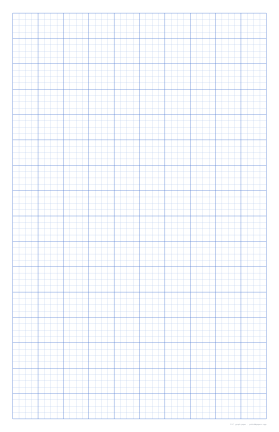
The large US sheet
11 × 17 inch paper is the biggest size most American offices handle routinely. It is exactly two Letter sheets joined along their long edge, so anything drawn at Letter size can be doubled up or enlarged to 129% without distortion. Architects, contractors and facility managers print reduced drawing sets at this size because it is large enough to read and small enough to fold into a binder. Called Tabloid in portrait and Ledger in landscape, it is the same sheet either way.
What fits on the page
With half-inch margins the drawing area is 10 × 16 inches. The quarter-inch default fills that with 40 × 64 squares, and the bold line every four squares marks whole inches. Other spacings that work well here:
- 1/8 inch gives 80 × 128 squares, room for a complete house and lot at 1/8 inch = 1 foot.
- 1/5 inch engineering gives 50 × 80, useful for schematics and large free-body diagrams.
- 1 inch gives 16 × 10 in landscape, a ready tabletop battle map of 80 × 50 feet.
Landscape uses
Ledger orientation is what most people want from 11 × 17 graph paper. The 64 × 40 quarter-inch grid suits project schedules and Gantt charts, where weeks run across and tasks run down; production calendars for a whole quarter; garden plans of long, narrow beds; and wide elevations of a house front or fence line.
For role-playing groups, the 1 inch battle map variation turns one sheet into a full encounter area. See our tabletop map scales guide for other conventions. If you want hexes instead, 1 inch hex paper can be set to the same sheet size.
Printing 11 × 17
Load the paper, choose Tabloid or 11 × 17 as the paper size, and set scaling to Actual size. Copy shops are used to this size; mention that the file must not be scaled. Measure ten bold inch blocks on the result before cutting or folding. If the only printer available takes Letter, print 1 inch graph paper or another spacing on Letter and tape sheets together instead of shrinking this one.
More graph paper sheets
- 1/4 inch graph paper (Letter & A4)
- 5 mm graph paper (A4, Letter & A3)
- 1/8 inch graph paper (Letter, A4 & Legal)
- 1 cm graph paper (centimeter squares)
- Engineering paper (5 squares per inch)
- 1 inch graph paper (Letter, A4 & 11×17)
- A4 graph paper (5 mm, 1 cm, 2 mm & more)
- 1/2 inch graph paper (large squares)
- 1 mm graph paper (millimetre paper)
- 2 mm graph paper (bold every centimeter)
- A3 graph paper for large drawings and plans
- Quilting graph paper
- Legal size graph paper (8.5 × 14 in)
Frequently asked questions
What is the difference between Tabloid and Ledger?
They are the same 11 × 17 inch sheet. Tabloid usually refers to portrait (11 wide, 17 tall) and Ledger to landscape (17 wide, 11 tall). Printers and print dialogs use both names.
How many 1/4 inch squares fit on 11×17 paper?
With half-inch margins the grid is 40 × 64 squares in portrait, or 64 × 40 in landscape. That is a 10 × 16 inch drawing area, more than twice the grid of a Letter page.
What scale works for a house plan on 11×17?
At 1/4 inch = 1 foot the sheet holds a 40 × 64 ft footprint, enough for most single-family homes. For a whole lot with yard and driveway, the Fine 1/8 inch variation covers 80 × 128 ft.
Can a normal home printer print 11×17?
Most standard home printers only take Letter and Legal. Wide-format inkjets and many office copiers accept 11 × 17, and copy shops can print the PDF for you. Ask them to print at 100% with no scaling.
Is 11×17 the same as A3?
Close but not quite. A3 is 297 × 420 mm, slightly wider and shorter than 11 × 17 (279.4 × 431.8 mm). Outside North America, use A3 graph paper instead.
Last updated · About us