Variations
What prints with the starting settings
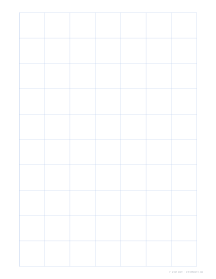
| Paper | US Letter — 215.9 × 279.4 mm (8.5 × 11 in) |
|---|---|
| Square size | 25.4 mm = 1″ |
| Squares per inch | 1 |
| Squares per cm | 0.394 |
| Grid on this page | 7 × 10 squares |
| Margins | 1/2″ |
| Line weight | 0.18 mm (bold 0.35 mm) |
| Print setting | Scale 100% / Actual size |
The tabletop gaming standard
One square per inch is the grid that tabletop role-players know from vinyl battle mats. The convention is simple: each square is 5 feet, so a 30-foot corridor is six squares long and a 20 × 20 ft room is a 4 × 4 block. Standard 25–28 mm miniatures have roughly one-inch bases, so every creature occupies a square and movement and spell ranges can be counted directly.
A Letter sheet in landscape holds a 10 × 7 encounter area, or 50 by 35 feet in game terms, which is plenty for a tavern brawl or a small crypt. For larger set pieces, switch to 11×17 graph paper or tape several pages together. Our guide to tabletop map scales covers other conventions in more detail.
Prototyping board games and puzzles
Designers use one-inch squares to sketch game boards, tile layouts and card grids before committing to artwork. A one-inch cell is large enough to hold a token, a die or a hand-drawn icon. Print the plain grid on cardstock, cut it into tiles, and you have a quick modular board for playtesting.
Teachers use the same paper for area and perimeter lessons with manipulatives: square tiles that are one inch on a side sit perfectly inside each cell. Children can build a shape from tiles, trace around it, and then count squares to find the area and edges to find the perimeter.
Settings that help
- The Bold every 5 squares variation marks 25-foot intervals, useful for long-range distances on outdoor maps.
- The dotted style keeps the grid visible under colored pencil or marker without fighting your artwork.
- Turn off Centre the grid on the page if you want the grid to begin exactly at the top-left margin, which makes lining up neighboring sheets easier.
At this size, a scaling error is obvious: if your printer shrinks the page by 3%, a seven-square row ends up about 5 mm short. Print at Actual size and check one square with a ruler before printing a whole campaign’s worth. A quick pass through the calibration wizard fixes small printer drift.
More graph paper sheets
- 1/4 inch graph paper (Letter & A4)
- 5 mm graph paper (A4, Letter & A3)
- 1/8 inch graph paper (Letter, A4 & Legal)
- 1 cm graph paper (centimeter squares)
- Engineering paper (5 squares per inch)
- A4 graph paper (5 mm, 1 cm, 2 mm & more)
- 1/2 inch graph paper (large squares)
- 1 mm graph paper (millimetre paper)
- 11×17 graph paper (Tabloid & Ledger)
- 2 mm graph paper (bold every centimeter)
- A3 graph paper for large drawings and plans
- Quilting graph paper
- Legal size graph paper (8.5 × 14 in)
Frequently asked questions
How many 1 inch squares fit on Letter paper?
With half-inch margins a portrait Letter page holds 7 × 10 squares; landscape gives 10 × 7. A4 also fits 7 × 10. For a bigger map, 11×17 Tabloid holds 10 × 16.
Is 1 inch the right scale for D&D-style miniatures?
Yes. Most tabletop role-playing games use 1 inch = 5 feet, and standard 25–28 mm miniatures have bases about one inch across, so one figure occupies one square.
How do I make a map bigger than one page?
Print several sheets, trim the blank margin from one edge of each, and tape them edge to edge so the lines continue across the seam. Smaller margins in Advanced options reduce trimming, and Tabloid paper cuts the number of seams in half.
Should I choose squares or hexes?
Squares are simpler for dungeons, buildings and anything with walls. Hexes treat all six directions equally, which suits wilderness travel. Our 1 inch hex paper uses the same scale.
Can I draw on the grid with wet-erase markers?
Not directly on paper, but you can slide the printout into a clear sheet protector or laminate it. Dry-erase and wet-erase markers then wipe off, and the grid stays reusable for many sessions.
Last updated · About us