Why formation matters
Two children can write a letter that looks the same, but if one starts at the bottom and goes round the wrong way, their writing will become slow and awkward when they try to join letters or write quickly. Teaching the correct starting point and direction early prevents habits that are hard to undo later.
Start dots and direction
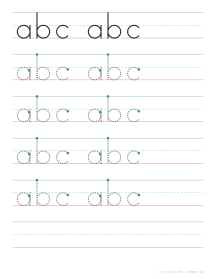
On our tracing sheets, each letter has a green dot where the pencil starts, and the dotted path follows the order of strokes children are usually taught. Most letters start at the top. The round letters c, a, d, g, o and q start near the top and go anticlockwise. Saying the movement aloud helps: for d, “round like a c, up tall, back down”.
Teach letters in families
Grouping letters by movement makes them easier to learn than alphabetical order. The national curriculum in England makes this explicit: Year 1 pupils should understand which letters belong to which handwriting “families”, letters formed in similar ways, and practise them together. Many schools name the families like this:
- Long laddersl i t j u y: start at the top, straight down
- One-armed robotsr n m h b k p: down, then back up and over
- Curly caterpillarsc a d o s g q e f: start with a c curve
- Zigzag monstersv w x z: straight diagonal strokes
Practise one family at a time, then mix them in short words such as cat, dog, hill and van.
A routine that works
- Model: show the letter large, describing each stroke.
- Trace: the child traces dotted letters, starting at each green dot.
- Copy: they write the letter beside a model.
- Write alone: on blank lines, without looking.
The name tracing maker builds exactly this sequence: a solid model row, dotted rows to trace, and a blank row to write alone.
A four-week plan for one family
| Week | Focus | Sheet |
|---|---|---|
| 1 | Big movements: air writing, sand, then tracing two letters | All dotted, 1 in letters |
| 2 | The rest of the family, one new letter a day | Model, trace, then write alone |
| 3 | Short words using only that family and ones already learned | Name or word tracing |
| 4 | Writing the family from memory on lined paper | Primary handwriting paper |
Choosing line size
Young children need big lines: 1 1/4 inch for preschool, 1 inch for kindergarten, then 3/4, 5/8 and 1/2 inch through the early grades. The ruling by grade guide shows each step at true size, and kindergarten writing paper is ready to print.
Common problems
| Problem | Try |
|---|---|
| Letters floating above the line | Paper with a red baseline, and the reminder that every letter “sits” on it |
| Reversals (b/d, p/q) | Practise the letters in separate sessions; usually outgrown by about age 7 |
| Starting at the bottom | Go back to start dots and say the start point aloud before each letter |
| Tight grip and tiredness | Shorter sessions, chunkier pencils, and plenty of drawing |
| Letters all different sizes | Three-line paper with a shaded middle zone for small letters |
Reversals deserve a word of reassurance. Understood.org describes them as typical and fairly common up to about second grade, and notes that reversing letters is not on its own a sign of dyslexia. If they continue well past age 7, mention it to the school.
Make it multisensory
Before paper, let children trace letters in sand, shaving foam or with a finger in the air, saying the movement as they go. Large movements build the motor memory that later shrinks to pencil size.
Printing
Print at 100% / Actual size so the lines keep their height. Laminated sheets with dry-wipe pens let children trace again and again.