Variations
What prints with the starting settings
| Paper | US Letter — 215.9 × 279.4 mm (8.5 × 11 in) |
|---|---|
| Hexagon side | 14.66 mm = 0.577″ |
| Across flats | 1″ |
| Across corners | 1.155″ |
| Margins | 1/2″ |
| Line weight | 0.18 mm (bold 0.35 mm) |
| Print setting | Scale 100% / Actual size |
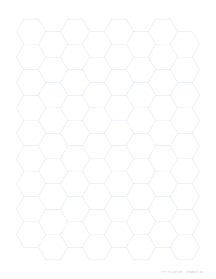
Built for miniatures
Hex grids give every space six equal neighbours, so movement and range work out the same in every direction, unlike squares where diagonals are a problem. That is why so many hex-and-counter wargames, skirmish games and RPG campaigns use them. One inch across the flats is the size gamers mean when they say “1-inch hexes”: a 25 mm round base fits inside one cell, and distances can be counted with the same ruler you use for movement trays.
Game masters sketch dungeon rooms, wilderness clearings and ship decks on this sheet, then slide it into a clear sleeve or under a sheet of acrylic for dry-erase use. Wargamers print it to prototype scenarios before committing to a mat, and board-game designers use it for playtest maps. For square-grid battle maps at the same scale, see 1 inch graph paper; the tabletop map scales guide compares both.
Letter, A4 or Tabloid
A Letter or A4 sheet covers a single room or small encounter, about the area of a tabletop skirmish in close quarters. Tabloid (11 × 17 inches) gives you about twice the play area and is the most practical size for an encounter map from one sheet; many office and copy-shop printers handle it. A3 is the metric near-equivalent. The hex size stays exactly one inch on every paper, so pieces from different sheets will match.
Getting a true inch on paper
The value that matters is the flat-to-flat width, so check it after printing: measure across one hex from straight side to straight side and you should see exactly 1 inch. If the hex measures about 0.95 inch, the print dialog shrank the page; choose Actual size or 100% and print again. For maps that span several sheets, set Pages in the PDF in Advanced options, print them together, and run the printer calibration once if your printer stretches one direction more than the other.
Lighter grid colours work best when you plan to draw terrain with markers, while the default grey keeps hex edges visible under painted miniatures.
For a hex-crawl campaign, many referees keep two sheets: a large-scale overland map on which each hex covers a region, and this one-inch sheet for the tactical scene when the party meets something. Numbering hexes along the top and side edges in pencil makes it easy to record where encounters, ruins and rivers sit, and to pass coordinates between sessions.
More hexagonal sheets
Frequently asked questions
How is a 1 inch hex measured?
Across the flats, meaning the distance between two opposite straight sides. That is the convention for miniature games and printed battle maps. These hexes are 1 inch (25.4 mm) across the flats, 1.155 inch (29.33 mm) corner to corner, and each side is 14.66 mm long.
Will 25 mm and 1 inch miniature bases fit?
A round 25 mm base is just under the 25.4 mm flat-to-flat width, so it sits inside one hex. Bases larger than an inch, such as 40 mm or 50 mm, cover several hexes, which many games treat as a large creature taking more space.
What scale does one hex represent?
For tactical combat, the common RPG convention is one inch = 5 feet, the same as a square battle grid. For overland or hex-crawl maps there is no single standard, so choose a distance per hex that suits your campaign and write it in the corner.
Should I use flat-top or pointy-top hexes?
Either works. Flat-top hexes stack in straight vertical columns, and pointy-top hexes line up in straight horizontal rows. Match whatever your rulebook or existing maps use so movement counts stay consistent.
How do I make a map bigger than one sheet?
Print the Tabloid size for a single large sheet. You can also print several Letter pages at Actual size, trim the margins and tape them together, lining up complete hex edges by eye; expect small adjustments where two sheets meet.
Last updated · About us