Variations
What prints with the starting settings
| Paper | US Letter — 215.9 × 279.4 mm (8.5 × 11 in) |
|---|---|
| Letter height | 3/4″ (x-height 3/8″) |
| Rows on this page | 8 |
| Words | 4 |
| Margins | 1/2″ |
| Line weight | 0.25 mm (bold 0.35 mm) |
| Print setting | Scale 100% / Actual size |
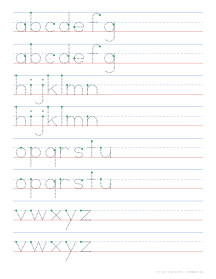
Every letter, with a starting point
Learning to write the alphabet is mostly about habits: where each letter starts, which way the pencil moves, and how tall each letter should be. This worksheet gives every lowercase letter a dotted shape to follow and a green dot at its start, on three-line rows that show which letters are tall, which are small and which drop below the line.
Letter families
Teaching letters in families, rather than in alphabetical order, helps children see the shared movements:
- Tall stick letters: l, t, i, then h, b, k.
- Round letters: c, o, a, d, g, q, all starting at the same point and moving anticlockwise.
- Hump letters: n, m, r, h, which go down, back up and over.
- Slant letters: v, w, x, y, z.
Once each family is familiar, this full alphabet sheet is a good review page.
Using the sheet
Trace each row slowly with a pencil, saying the letter name or sound. Then try writing the letters on blank kindergarten handwriting paper. To trace a child’s own name, use the name tracing maker.
Printing
Print at 100% / Actual size on Letter or A4. For daily practice, put one copy in a plastic sleeve and trace with a dry-wipe pen.
More name tracing sheets
Frequently asked questions
How is the alphabet laid out?
In four groups (a to g, h to n, o to u, v to z), each traced on two rows, so the page holds the whole alphabet twice on 3/4 inch lines.
What do the green dots mean?
Each letter starts at its green dot. Tall letters like b, h, k and l begin at the top line; round letters like a, c, d, g and q begin just below the midline on the right and go anticlockwise, and o starts at the top of its circle.
Is there an uppercase version?
Yes. Choose the uppercase variation for capitals A to Z in the same layout.
Which handwriting style is this?
A plain ball-and-stick manuscript, close to the print styles taught in many US and UK schools. Letter shapes may differ slightly from your school's scheme, for example in the tail of y or the shape of k.
Last updated · About us