Variations
What prints with the starting settings
| Paper | US Letter — 215.9 × 279.4 mm (8.5 × 11 in) |
|---|---|
| Letter height | 3/4″ (x-height 3/8″) |
| Rows on this page | 8 |
| Words | 4 |
| Margins | 1/2″ |
| Line weight | 0.25 mm (bold 0.35 mm) |
| Print setting | Scale 100% / Actual size |
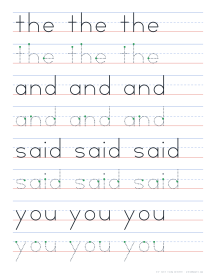
Read it, trace it, write it
Sight words, also called high-frequency or tricky words, appear so often in early reading books that children need to recognise them instantly. Writing them reinforces that recognition. This sheet gives each word a solid model row and a dotted row repeated across the page, so children see and trace the same word several times in one go.
Making weekly lists
Most reading programmes introduce a few new words each week. Type that week’s words into the generator to make a matching sheet in seconds:
- Pre-primer words such as a, and, big, can, go, I, is, look, me, my, see, the, to, we, you.
- Primer words such as all, are, at, came, did, do, eat, get, have, like, new, now, she, there, was.
- Your school’s list, whatever words it uses.
Activity ideas
- Say the word, trace it once, then read the whole row aloud.
- Colour the dotted word in a different colour on each repeat.
- Find the same words in a book and count how often they appear.
- Hide the words in a word search for kids.
Printing
Print at 100% / Actual size on Letter or A4. A copy in a plastic sleeve can be traced again and again with a dry-wipe pen.
More name tracing sheets
Frequently asked questions
Which words are on the sheet?
The, and, said and you, four very common early sight words. Each gets two rows: one solid model row and one dotted row, repeated across the line.
Can I use my own word list?
Yes. Type up to twelve words in the generator, separated by commas or new lines. Four to six words per page gives each word enough rows.
Why trace sight words?
Many sight words can't be sounded out easily, so children learn them by seeing and writing them often. Tracing while saying the word links its shape, spelling and sound.
What size are the letters?
3/4 inch from the top line to the baseline, the size of first-grade handwriting paper. Choose 1 inch for younger children.
Last updated · About us