Variations
What prints with the starting settings
| Paper | US Letter — 215.9 × 279.4 mm (8.5 × 11 in) |
|---|---|
| Letter height | 1″ (x-height 1/2″) |
| Rows on this page | 6 |
| Words | 2 |
| Margins | 1/2″ |
| Line weight | 0.25 mm (bold 0.35 mm) |
| Print setting | Scale 100% / Actual size |
Writing numbers the right way round
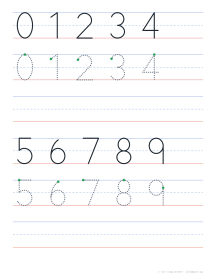
Reversed numbers are very common when children start writing: 2, 3, 5, 7 and 9 are often written back to front. Tracing helps by fixing the starting point and direction. The green dot shows where to begin, the dotted path shows which way to go, and the solid model row above shows the finished shape.
A simple routine
- Look: point to each digit on the model row and say its name.
- Trace: follow the dots, starting at every green dot.
- Write: fill the empty row without looking, then compare with the model.
Ten minutes a day is plenty. When the numbers are secure, move on to writing them in a hundreds chart or on a number line.
Number rhymes
Many families and teachers use short rhymes for the movements, such as “across the sky and down from heaven, that’s the way to make a seven”. Saying the rhyme while tracing helps the direction stick.
Printing
Print at 100% / Actual size. For a reusable sheet, laminate it and trace with a dry-wipe pen; wipe clean and start again.
More name tracing sheets
Frequently asked questions
How is the page arranged?
Two groups, 0 to 4 and 5 to 9, each with three rows: solid digits to copy, dotted digits to trace, and an empty row for writing alone.
Where does each number start?
At the green dot. Most digits start at the top: 1, 4, 5 and 7 with a straight stroke, 2, 3 and 9 near the top left or right, and 0, 6 and 8 at the top of their curve.
How tall are the numbers?
1 inch from the baseline to the top line. Numbers are full height, like capital letters, so they reach the top line.
Can I add more numbers?
Yes. In the generator, type any numbers separated by spaces, with a comma to start a new group, such as 10 to 20 or a phone number.
Last updated · About us