Variations
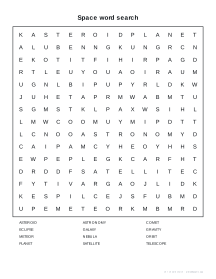
What prints with the starting settings
| Paper | US Letter — 215.9 × 279.4 mm (8.5 × 11 in) |
|---|---|
| Grid | 15 × 15 letters |
| Words hidden | 12 of 12 |
| Margins | 1/2″ |
| Line weight | 0.18 mm (bold 0.35 mm) |
| Print setting | Scale 100% / Actual size |
For experienced searchers
Easy word searches keep words left to right and top to bottom, so they can be found by reading. Hard ones use every direction, which means scanning for the first letter and then checking all eight neighbours. A 15 × 15 grid with a dozen long words takes a good while to finish, even for regular solvers.
Tips for solving
- Hunt rare letters first: words containing Q, X, Z, J or K stand out.
- Look for doubles: pairs like LL, EE or SS are easy to spot in a grid.
- Turn the page: reading the grid upside down makes backwards words read forwards.
- Cross off as you go, both in the grid and the word list.
Making a themed puzzle
Pick a theme with long words, such as science terms, countries, novels or team names, and mix lengths so some words are quick wins. Twelve to fifteen words suit a 15 × 15 grid; for more, choose 20 × 20. For easier puzzles, see the large-print maker, and for another challenge, hard sudoku or hard mazes.
Printing
Print at 100% / Actual size. Change the puzzle number to reshuffle the same words into a new grid.
More word search maker sheets
Frequently asked questions
What makes it hard?
Words can run in all eight directions, including backwards and backwards diagonals, and the 15 × 15 grid has 225 letters to search. Longer words also make good decoys, because their pieces appear in other words.
Can I use my own words?
Yes. Type your list in the generator, one per line or separated by commas, and give the puzzle a title. The generator reports how many words it placed.
How big can the grid be?
From 8 × 8 up to 20 × 20. Bigger grids are harder but have smaller letters.
Is there an answer key?
Yes, an answer page with every word highlighted follows the puzzle.
Last updated · About us