Variations
What prints with the starting settings
| Paper | US Letter — 215.9 × 279.4 mm (8.5 × 11 in) |
|---|---|
| Range | 0 to 100 in steps of 10 |
| Lines per page | 8 |
| Margins | 1/2″ |
| Line weight | 0.18 mm (bold 0.35 mm) |
| Print setting | Scale 100% / Actual size |
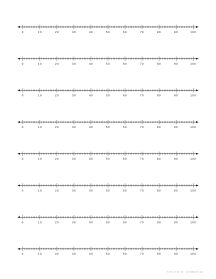
The hundreds chart, stretched out
A hundreds chart shows the numbers to 100 in rows; a number line shows them in one long row. The line makes distance visible: 48 is just short of 50, and 72 is closer to 70 than to 80. That makes it the natural tool for rounding, estimating and adding by jumps of ten.
Activities
- Jumps of ten: start at 7 and jump in tens to 97, writing each landing number.
- Rounding: mark 34, 65 and 89 and round each to the nearest ten.
- Number between: shade the numbers between 45 and 55.
- Adding on: model 38 + 25 as a jump of 20 then a jump of 5.
Choosing the labels
Labelling in tens works for most ages from about seven up. Labelling in fives gives younger children more landmarks, and the tens-only version without ticks is best for estimation. With 100 ticks across the page, the small ticks are about 1.7 mm apart, so a sharp pencil helps.
Printing
Print at 100% / Actual size on Letter or A4, ideally on bright white paper so the fine ticks stay clear.
More number lines sheets
Frequently asked questions
How are the numbers marked?
0, 10, 20 and so on up to 100 are labelled, with nine small ticks between each pair, so every whole number has its own tick.
How do I teach rounding with it?
Mark the number, then look at the labelled tens on either side. Whichever is closer is the rounded value; numbers ending in 5 round up by convention.
What is the empty-labels version for?
Estimating. With only 0 and 100 printed, children place a number like 37 by eye, then check against a labelled line.
Can I make 0 to 1,000?
Yes. In the generator, set the end to 1,000 and the labelled step to 100.
Last updated · About us