Variations
What prints with the starting settings
| Paper | US Letter — 215.9 × 279.4 mm (8.5 × 11 in) |
|---|---|
| Letter height | 3/4″ (x-height 3/8″) |
| Rows on this page | 8 |
| Lines | 2 |
| Margins | 1/2″ |
| Line weight | 0.25 mm (bold 0.35 mm) |
| Print setting | Scale 100% / Actual size |
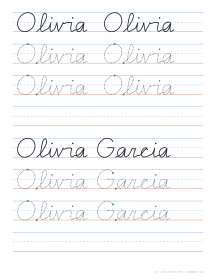
Your name in joined writing
Writing their own name is one of the first reasons children want to learn cursive. This sheet prints the name as a solid model, then dotted rows with a green dot at each starting point, then a blank row.
How the name is written
The first letter is a printed capital, then the pen starts again with a lead-in for the joined lowercase letters, so most names have two starting dots. Letters such as o and v join from the midline, which you can see in “Olivia” between the v and the i.
Practice ideas
- Trace the name every morning for a week, then try the blank row with no help.
- Make a card or a label for a book with the name in cursive.
- Add a surname on a second line once the first name is easy.
For print letters instead of cursive, use the name tracing worksheet.
Printing tips
Print at 100% on Letter or A4. For a reusable sheet, slip it into a plastic sleeve and trace with a dry-wipe pen.
More cursive tracing sheets
Frequently asked questions
How do I make a worksheet for my child's name?
Replace the example with the name, one per line: a first name on one line and the full name on the next works well. Each line gets its own block of rows.
Why is the capital letter printed?
Capitals on these sheets stand alone and are not joined, so the name starts with a familiar printed capital and the rest is joined cursive. The green dots show the two starting points.
Can I use it for signatures?
Yes. Older children and adults practising a signature can type their full name and choose smaller letters, such as 1/2 inch, to fit it on one row.
Does it work for names with accents?
Letters without a cursive form, such as accented letters, are left as a space, so check the preview. Type the name without accents if a letter is missing.
Last updated · About us