Variations
What prints with the starting settings
| Paper | US Letter — 215.9 × 279.4 mm (8.5 × 11 in) |
|---|---|
| Layout | Staff (5 lines) |
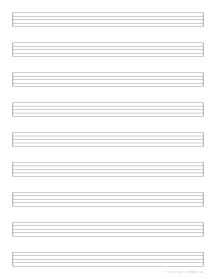
| Staves on this page | 9 |
| Line gap | 3.5 mm (staff 14 mm tall) |
| Margins | 1/2″ |
| Line weight | 0.2 mm (bold 0.35 mm) |
| Print setting | Scale 100% / Actual size |
Room for every note
On standard manuscript paper, note heads are only about 2 mm across, which is fine for experienced musicians but hard for small hands and new readers. Wider spacing makes it clear whether a note sits on a line or in a space, which is the most common confusion for beginners.
Large print for low vision
Large staff paper is also large-print manuscript paper. Musicians with low vision often find standard staves, with lines barely 2 mm apart, impossible to write on accurately. At 3.5 mm, and especially at the 5 mm extra-large setting, lines and spaces are easy to tell apart. For the clearest page, open Advanced options and make the lines darker and slightly heavier, so they show up strongly against white paper; a dark felt-tip pen then gives bold, readable noteheads.
Teaching ideas
- Line and space notes: write the treble clef notes EGBDF on lines and FACE in spaces, one per bar.
- Copying melodies: copy a short tune from a book, saying the note names aloud.
- Composing: write a four-bar melody using only three notes.
- Rhythm practice: write rhythms on a single line first, then on the staff.
Moving on
Once notes are neat and confident, move to standard staff paper, or use the grand staff for piano. The music paper guide explains staff sizes and layouts.
Printing
Print at 100% / Actual size on Letter or A4. For a class demonstration, the extra-large staves on Tabloid or A3 make a wall chart that students can read from their seats.
More sheet music & tab sheets
Frequently asked questions
How big are the staves?
Lines are 3.5 mm apart, so each staff is 14 mm tall, about 60% bigger than the standard 2.2 mm spacing. The extra-large variation uses 5 mm.
Who is large staff paper for?
Young children learning to write notes, beginners of any age, people with low vision, and teachers making examples to show a class.
How many staves fit on a page?
9 staves on Letter or A4, compared with 12 on standard staff paper. The extra-large variation fits 6 on Letter and 7 on A4, and the grand staff variation gives 4 piano systems on Letter and 5 on A4. The wider gaps leave room for lyrics, note names and fingering.
Can I make it even bigger?
Yes, the generator allows up to 5 mm between lines. Print on Tabloid or A3 for a wall chart.
Last updated · About us